A successful enterprise AI implementation in 202ư 6 has become the definitive marker between industry leaders and those destined for obsolescence. Despite the billions of dollars poured into artificial intelligence over the last three years, a sobering statistic remains: nearly 87% of AI projects never make it past the prototype stage. At NKKTech Global, we have navigated over 150 unique AI journeys across the Japan and Singapore markets. We have seen firsthand that while the technology is transformative, the strategy behind the deployment is what determines survival. This guide serves as a strategic manual to ensure your organization joins the elite 13% that successfully operationalize intelligence to drive real-world growth.
1. Analyzing the Landscape of Enterprise AI Implementation
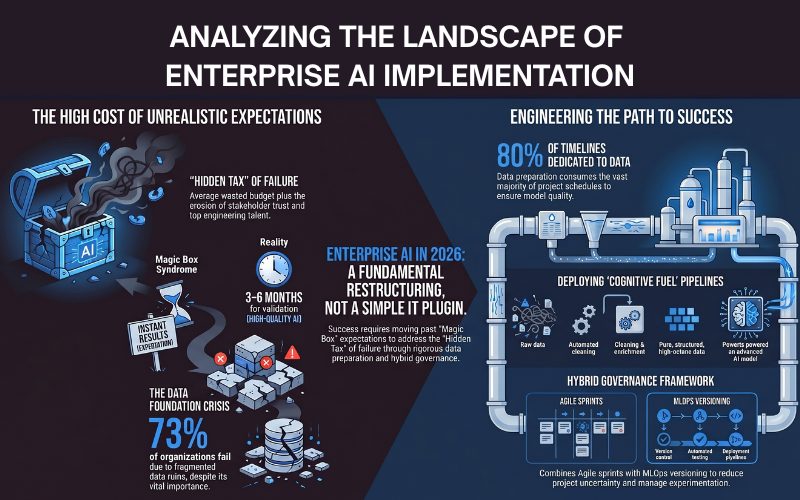
As we navigate the complexities of 2026, an enterprise AI implementation is no longer a standalone IT project; it is a fundamental restructuring of the corporate nervous system. To understand why so many initiatives fail, we must first look at the “Hidden Tax” of failure. When a project collapses, the loss isn’t just the average $2.4 million in wasted budget—it is the erosion of stakeholder trust and the drain of top-tier engineering talent who grow weary of building “vaporware.”
The Peril of Unrealistic Expectations and Timeline Pressure
The most frequent cause of failure in an enterprise AI implementation is what we call the “Magic Box Syndrome.” Influenced by hyper-optimized demos, business stakeholders often expect AI to deliver instant, perfect insights with zero training time. This disconnect creates immense pressure on CTOs to rush models into production. However, the reality of 2026 remains unchanged: a high-quality, reliable AI system requires a minimum of 3 to 6 months for rigorous training, validation, and safety alignment. Rushing this window almost always results in model drift and catastrophic user adoption failure.
The Data Quality Crisis: Moving Beyond “Garbage In, Garbage Out”
You cannot build a skyscraper on a swamp, yet 73% of organizations attempt an enterprise AI implementation on a foundation of fragmented, poor-quality data. In 2026, data preparation still consumes up to 80% of the total project timeline. The challenges have evolved from simple “missing records” to more complex issues like biased training sets and inconsistent data formats across global systems. At NKKTech, our first month of any engagement is dedicated exclusively to data auditing and the establishment of automated cleaning pipelines, ensuring that the “cognitive fuel” for your AI is pure and high-octane.
Inadequate Governance for Experimental Technologies
Traditional project management, often rigid and linear, is the enemy of a successful enterprise AI implementation. Artificial intelligence is inherently experimental; it requires a tolerance for uncertain outcomes during the training phase and the agility to pivot based on model performance. Many CTOs struggle because their current organizational structure doesn’t support the cross-functional collaboration required between data scientists, DevOps specialists, and domain experts. Implementing a hybrid governance framework—one that combines Agile sprints with specific MLOps versioning—is the only way to reduce project uncertainty.
2. Strategic Blueprints for a Resilient Enterprise AI Implementation
To move from a “cool demo” to a production-ready asset, your enterprise AI implementation must be built on three non-negotiable pillars: infrastructure maturity, talent diversity, and human-centric change management. At NKKTech Global, we’ve refined these pillars into a repeatable success framework that has helped firms in Singapore and Japan scale their intelligence 40% faster than the industry average.
Infrastructure Readiness: Cloud and Edge Scalability
A significant portion of failed projects stumble because the underlying hardware cannot breathe. A modern enterprise AI implementation requires infrastructure that can scale 10x during peak training phases and provide sub-100ms latency for end-users. In 2026, we are seeing a massive shift toward “Edge AI”—processing data closer to the source to enhance privacy and speed. CTOs must ensure their cloud architecture is not only robust but “AI-First,” featuring native integration with model monitoring tools and real-time data processing capabilities.
Bridging the Talent Gap through Hybrid Team Structures
The AI talent shortage is no longer a myth; it is a permanent hurdle. However, the secret to a successful enterprise AI implementation is not just hiring expensive data scientists. It is about building a “Symphony of Roles.” You need Data Engineers to build the pipelines, MLOps specialists to automate deployment, and most importantly, Domain Experts who provide the business context the AI needs to be relevant. NKKTech Global’s team of 50+ engineers acts as a “Strategic Extension” to your department, providing these specialized roles instantly and eliminating the 6-month recruitment cycle that kills project momentum.
Human-Centric Change Management and User Adoption
Technical excellence is worthless if your employees are afraid of the tool. Many enterprise AI implementation projects fail because they ignore the “Human Coefficient.” Change management is about more than just a 1-hour training session; it is about involving end-users in the design phase from day one. By creating “AI Champions” across different departments, you turn the technology from a perceived threat into a valuable partner. We recommend establishing feedback loops where staff can report model inaccuracies, creating a culture of continuous improvement rather than silent resistance.
3. Operationalizing Your Enterprise AI Implementation for ROI
In the boardroom, the only metric that truly matters for an enterprise AI implementation is the Return on Investment. To achieve this, CTOs must stop looking for “total transformation” and start looking for “surgical strikes.” By focusing on high-impact, low-risk pilots, you build the internal momentum and capital required for a full-scale rollout.
Starting with High-Impact, Low-Risk Pilot Programs
The fastest way to kill an enterprise AI implementation is to attempt to automate your most complex, high-risk process first. Instead, choose a pilot that can be completed in under 4 months with clear, measurable ROI.
- Predictive Maintenance: For manufacturing giants looking to reduce downtime.
- Automated Document Processing: For legal and finance teams buried in paperwork.
- Intelligent Triage Chatbots: For customer service centers handling repetitive queries.
These “Quick Wins” provide the data and the confidence needed to tackle more ambitious AI-first architectures later in the year.
Continuous Learning: The Post-Production Retention Loop
The most dangerous misconception in 2026 is that an enterprise AI implementation ends at deployment. In reality, that is when the real work begins. AI models are living organisms; they “degrade” or “drift” as real-world conditions change. Without automated retraining pipelines and quarterly performance audits, your model will eventually provide outdated or incorrect advice. At NKKTech, we implement “Shadow Monitoring” systems that constantly check production models against ground-truth data, ensuring your AI stays as accurate on day 1,000 as it was on day 1.
The Role of Strategic Partnerships and Offshore Excellence
Why are companies in Japan and Singapore increasingly looking toward Vietnam for their enterprise AI implementation? The answer is a unique combination of elite technical talent and aggressive cost efficiency. Partnering with a specialized AI firm like NKKTech Global provides immediate access to proven frameworks, reducing your time-to-market by nearly 50%. Offshore partnerships allow you to maintain a 24/7 development cycle, where Vietnamese teams can refine models and clean data while your domestic team focuses on high-level strategy and stakeholder alignment.
4. Future-Proofing: The Trends of late 2026

As we move deeper into the year, the definition of a successful enterprise AI implementation continues to evolve. Staying ahead of these three trends will ensure your organization remains competitive through 2027 and beyond.
The Rise of Agentic Workflows
We are moving past “Chatbots” and toward “Agents.” In a modern enterprise AI implementation, the system doesn’t just answer questions—it takes action. This might mean an AI that not only identifies a supply chain bottleneck but also automatically contacts alternative vendors and drafts a new procurement contract for human approval.
Responsible AI and Explainability (XAI)
In 2026, “The AI said so” is no longer an acceptable answer for regulators or customers. A successful enterprise AI implementation must prioritize “Transparency.” We are seeing a massive shift toward Explainable AI (XAI), where models can provide a clear audit trail of why a certain decision was made. This is particularly critical in the financial and healthcare sectors where compliance is non-negotiable.
Edge-to-Cloud Hybrid Architectures
The future of enterprise AI implementation is local. To meet the strict data privacy requirements of Decree 13 in Vietnam or GDPR in Europe, companies are keeping sensitive data on-site using Edge AI, while utilizing the cloud only for massive model training tasks. This hybrid approach offers the best of both worlds: the power of the cloud and the security of the local server.
Conclusion: The Time for Decisive Action is Now
The difference between a successful and a failed enterprise AI implementation ultimately comes down to execution discipline, realistic expectations, and access to the right expertise. While the challenges of 2026 are real, they are not insurmountable. Organizations that build a solid triple-foundation of data, infrastructure, and culture will emerge as the dominant forces of the next decade.
At NKKTech Global, we don’t just build models—úng tôi kiến tạo những giải pháp thay đổi cục diện kinh doanh. Our team of 50+ AI specialists is ready to help you navigate the 87% failure gap and place your organization among the world’s most intelligent enterprises.
Are you ready to join the elite group of successful AI pioneers? We invite you to share your thoughts in the comments below: What is the biggest hurdle your organization faces regarding AI today? Let’s discuss a solution.
🚀 Ready to transform your business with AI?
Get a free 30-minute consultation with our AI experts
✅ Web App from $2,000 | ✅ AI Transformation from $800/mo | ✅ AI Auto Sales
Contact Information:
🌎Website: https://nkk.com.vn
📩Email: contact@nkk.com.vn
💼LinkedIn: https://www.linkedin.com/company/nkktech