Why Voicebot and Chatbot Matter More Than Ever
In recent years, artificial intelligence has moved far beyond experimentation. For many organizations, AI has become a core operational layer, supporting customer service, sales, and internal processes at scale.
Among the most widely adopted AI solutions today are Voicebots and Chatbots. However, many businesses still struggle to answer critical questions:
- In the Voicebot vs Chatbot debate, which solution is more suitable?
- Should businesses implement one or both?
- How can AI deliver real operational value rather than just automation for automation’s sake?
This article explores those questions from a practical, enterprise-focused perspective, drawing on real-world AI deployment experience from NKK Tech.
What Is a Chatbot and When Does It Work Best?
A Chatbot is an AI system that interacts with users through text-based conversations. It is commonly deployed on websites, messaging platforms, mobile apps, and internal enterprise tools.
Where Chatbots Deliver the Most Value
Chatbots are particularly effective in scenarios such as:
- Answering frequently asked questions (FAQs)
- Providing product or service information
- Supporting customers outside business hours
- Collecting and qualifying leads
- Guiding users through standardized processes
Key Advantages of Chatbots
- Lower implementation and maintenance costs
- Fast deployment and easy updates
- Seamless integration with CRM and business systems
- Ideal for users comfortable with digital text interfaces
Limitations to Consider
- Less effective for urgent or emotional interactions
- Limited accessibility for non-digital or older user groups
- Not suitable for voice-first customer journeys
In summary, Chatbots are a strong choice for businesses looking to scale digital interactions efficiently while keeping costs under control.
What Is a Voicebot and Why Is It Gaining Importance?
A Voicebot is an AI-powered system capable of understanding and responding through natural speech in real time. Voicebots are most commonly used in call centers, hotlines, and customer service operations.
Typical Use Cases for Voicebots
- Handling high volumes of inbound calls
- Verifying customer information
- Booking appointments or checking order status
- Payment reminders and follow-up calls
- First-line customer support
Strengths of Voicebots
- More natural, human-like interaction
- 24/7 availability without capacity limits
- Significant reduction in call center workload
- Improved customer experience at critical touchpoints
Challenges of Voicebot Deployment
- Higher initial investment compared to chatbots
- Requires high-quality voice data and scenario design
- Careful conversation flow design is essential
Voicebots are highly valuable for organizations where voice communication is central to customer experience, such as finance, insurance, logistics, healthcare, and public services.
Voicebot vs Chatbot: A Practical Comparison for Businesses
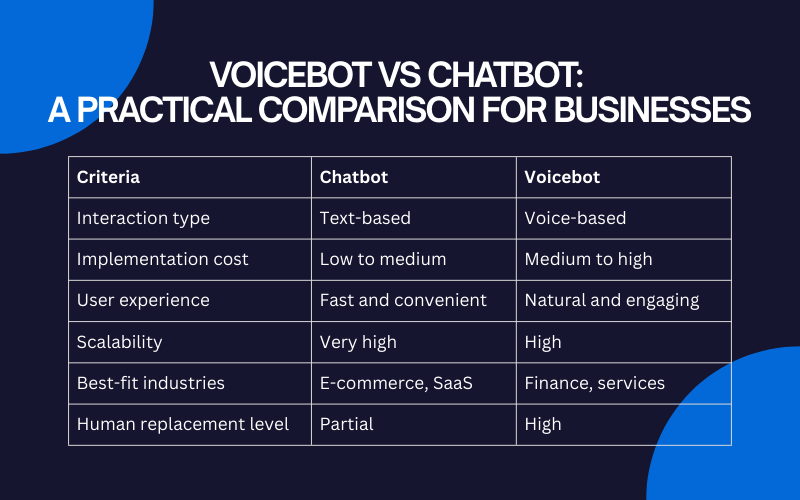
| Criteria | Chatbot | Voicebot |
| Interaction type | Text-based | Voice-based |
| Implementation cost | Low to medium | Medium to high |
| User experience | Fast and convenient | Natural and engaging |
| Scalability | Very high | High |
| Best-fit industries | E-commerce, SaaS | Finance, services |
| Human replacement level | Partial | High |
When businesses compare voicebot vs chatbot, the real question is not about technology trends, but about which solution delivers practical value in daily operations. In most enterprise use cases, chatbots are the entry point for conversational AI because they are faster to deploy, easier to manage, and highly effective for text-based workflows such as customer support, FAQs, lead qualification, and internal process automation. In the voicebot vs chatbot discussion, chatbots often win on cost efficiency and implementation speed.
Voicebots, by contrast, are designed for spoken, real-time interactions and are commonly used in call centers, appointment scheduling, hotline automation, and outbound calling campaigns. In a voicebot vs chatbot comparison, voicebots stand out when hands-free communication, speed, and accessibility are critical. A well-designed voicebot can reduce call handling time, improve first-contact resolution, and scale voice interactions without increasing headcount. However, voicebots usually require higher upfront investment due to speech recognition accuracy, background noise handling, language variation, and stricter user experience expectations.
From a business perspective, choosing between voicebot vs chatbot should depend on user behavior, interaction complexity, and risk tolerance. Chatbots offer clearer intent tracking, lower error rates, and simpler compliance controls, making them ideal for structured and data-driven tasks. Voicebots excel in conversational and time-sensitive scenarios but require continuous tuning to avoid misrecognition and user frustration.
In practice, the most effective strategy is often not voicebot vs chatbot, but voicebot and chatbot. Many enterprises combine both in a unified conversational AI architecture, using chatbots for structured workflows and voicebots for inbound or outbound calls. This hybrid approach maximizes automation ROI, improves customer experience, and enables businesses to scale AI interactions sustainably..
Real-World Implementation Insights from NKK Tech
Based on multiple enterprise AI projects, NKK Tech observes a clear adoption pattern:
- Small and mid-sized businesses typically start with Chatbots
- Growing companies introduce Voicebots to handle increasing demand
- Large enterprises adopt a hybrid model combining Voicebots, Chatbots, and AI backends
In this model:
- Chatbots manage digital touchpoints and lead qualification
- Voicebots handle calls, verification, and customer care
- AI backends (RAG, CRM, ERP) ensure consistent and accurate data
This approach helps businesses:
- Reduce operational costs by 30–50%
- Improve response speed and service quality
- Scale AI systems smoothly as operations grow
When Should Businesses Use Both Voicebots and Chatbots?
Combining Voicebots and Chatbots is highly recommended when:
- Customer interactions occur across multiple channels
- The user base spans different age groups and preferences
- Customer service workflows are complex
- The business needs to scale without increasing headcount
This integrated model is increasingly common in enterprise AI systems developed by NKK Tech.
Choosing the Right AI Strategy from the Start
The discussion around Voicebot vs Chatbot is not about competition.
It is about strategic alignment with real business needs.
When implemented correctly:
- AI goes beyond cost reduction
- AI becomes a long-term competitive advantage
Build Your AI Foundation with NKK Tech
Are you considering deploying Voicebots, Chatbots, or a combined AI solution for your business?
NKK Tech supports:
- Practical AI strategy consulting
- AI MVP development in 3–6 weeks
- Production-ready AI systems tailored to enterprise needs
📩 Contact NKK Tech today to design an AI roadmap that delivers measurable business impact.
Contact Information:
🌎Website: https://nkk.com.vn
📩Email: contact@nkk.com.vn
📌LinkedIn: https://www.linkedin.com/company/nkktech