



Table of Contents
RAG in FinTech is rapidly emerging as a core architecture for building reliable, enterprise-grade AI systems in the financial industry. As banks, fintech platforms, and financial service providers scale their digital operations across markets such as Singapore, Australia, the United States, and Europe, the need for accurate, secure, and explainable AI becomes critical.
Traditional AI models often struggle with outdated information or hallucinated responses. This is where RAG in FinTech—Retrieval-Augmented Generation—creates a clear advantage. By combining large language models with real-time data retrieval, AI systems can generate responses grounded in verified, up-to-date financial information.
At NKKTech Global, enterprise AI systems are designed using RAG within FinTech architectures to ensure accuracy, compliance, and scalability across financial applications, including customer support, advisory systems, and internal knowledge automation.
Why RAG matters in financial AI systems
Financial services demand precision. Incorrect information can lead to regulatory issues, financial loss, and reputational damage.
This is why RAG in FinTech is becoming essential.
Instead of relying solely on pre-trained knowledge, RAG systems retrieve relevant data from trusted sources such as:
- Internal databases
- Policy documents
- Transaction systems
- Compliance frameworks
The AI then generates responses based on this retrieved data.
This approach significantly improves:
- Accuracy
- Transparency
- Trustworthiness
For enterprises, RAG in FinTech enables AI agents to operate safely in high-stakes environments.
Key benefits of RAG in FinTech
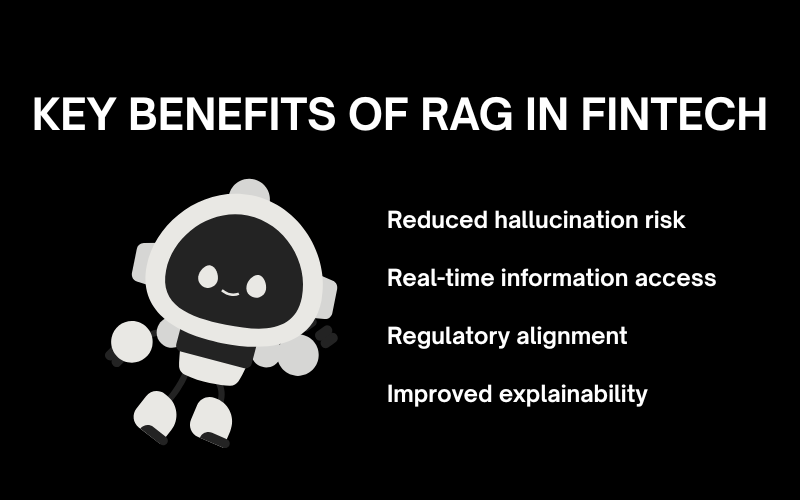
Organizations adopting RAG in FinTech gain several advantages.
Reduced hallucination risk
AI responses are grounded in real data, reducing incorrect outputs.
Real-time information access
Systems can retrieve the latest financial data instead of relying on outdated training sets.
Regulatory alignment
RAG systems can reference compliance documents, ensuring responses follow regulations.
Improved explainability
AI outputs can be traced back to source documents.
These benefits make RAG in FinTech a preferred architecture for enterprise AI deployment.
5 powerful AI agent use cases in FinTech
Below are five high-impact use cases where RAG in FinTech is delivering real business value.
1. AI customer support agents with accurate financial data
Customer support is one of the most common applications of AI in fintech.
However, financial queries often require precise and up-to-date information.
With RAG in FinTech, AI agents can retrieve:
- Account-related policies
- Product details
- Transaction guidelines
For example, when a customer asks about fees or account limits, the system retrieves the latest policy document before generating a response.
This ensures accuracy and builds customer trust.
2. Compliance and regulatory assistance
Financial institutions must comply with strict regulations.
AI agents powered by RAG in FinTech can assist compliance teams by retrieving relevant regulations and internal policies.
Use cases include:
- Answering compliance-related questions
- Supporting audit processes
- Providing regulatory summaries
This reduces manual effort and ensures that teams always reference the correct information.
3. Personalized financial advisory systems
AI-driven advisory platforms are becoming more common in fintech.
However, recommendations must be based on accurate data and clear logic.
With RAG in FinTech, AI agents can:
- Retrieve customer financial profiles
- Access market data
- Reference investment guidelines
This allows the system to generate personalized and data-driven recommendations.
For enterprises, this improves both service quality and user engagement.
4. Internal knowledge management for financial teams
Large financial organizations manage vast amounts of internal documentation.
Employees often spend significant time searching for information.
AI agents using RAG in FinTech can act as internal assistants that retrieve and summarize documents instantly.
Examples include:
- Product documentation
- Risk management guidelines
- Operational procedures
This improves productivity and reduces internal workload.
5. Fraud detection and investigation support
Fraud detection systems generate alerts, but investigating these alerts requires context.
AI agents powered by RAG in FinTech can assist by retrieving relevant transaction data, historical patterns, and policy rules.
This helps analysts:
- Understand suspicious activities
- Review transaction histories
- Make faster decisions
By combining retrieval and reasoning, RAG in FinTech enhances fraud investigation workflows.
Technology architecture behind RAG in FinTech
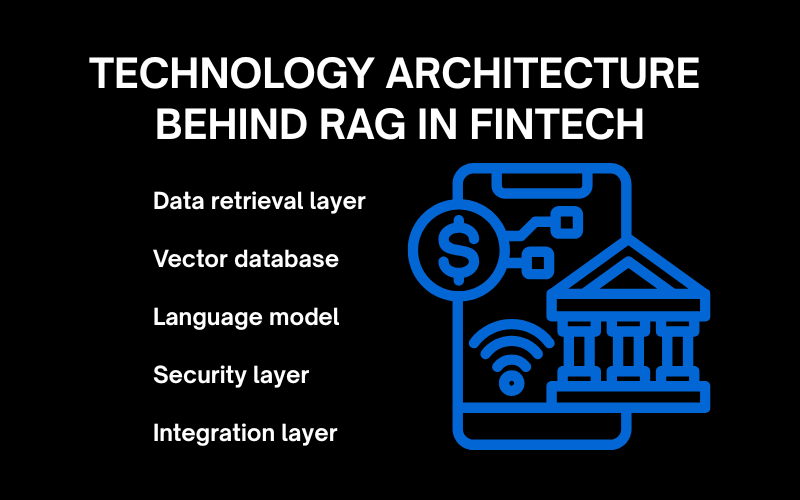
Implementing RAG in FinTech requires a well-designed architecture.
Core components include:
Data retrieval layer
Connects to databases, APIs, and document storage systems.
Vector database
Stores embeddings for fast similarity search.
Language model
Generates responses based on retrieved context.
Security layer
Ensures data access control and compliance.
Integration layer
Connects AI systems with CRM, banking systems, and analytics platforms.
At NKKTech Global, RAG architectures are built with enterprise-grade security and scalability to support financial applications across global markets.
Challenges in deploying RAG systems in fintech
Despite its advantages, implementing RAG in FinTech comes with challenges.
Data quality
AI systems are only as good as the data they retrieve.
Latency
Real-time retrieval can introduce delays if not optimized.
Security risks
Sensitive financial data must be protected.
Complex integration
Connecting multiple data sources requires strong engineering capabilities.
Enterprises must address these challenges to fully benefit from RAG in FinTech.
RAG in FinTech for global markets
For companies operating in regions such as Singapore, Australia, the US, and Europe, RAG in FinTech offers additional advantages.
It allows AI systems to:
- Adapt to regional regulations
- Support multiple languages
- Deliver localized financial insights
This flexibility makes RAG architectures ideal for global fintech platforms.
Future trends in RAG for fintech
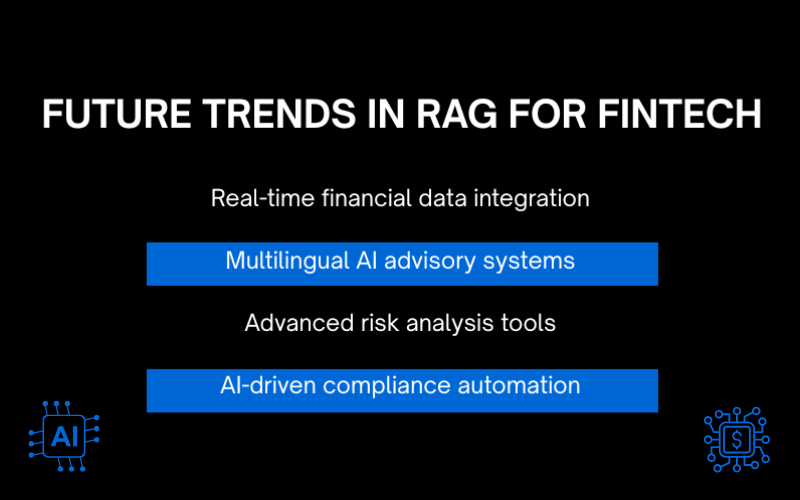
The adoption of RAG in FinTech is expected to grow rapidly.
Emerging trends include:
- Real-time financial data integration
- Multilingual AI advisory systems
- Advanced risk analysis tools
- AI-driven compliance automation
These developments will further strengthen the role of RAG in financial AI systems.
Conclusion
Financial services require AI systems that are accurate, reliable, and compliant.
Traditional models alone are not sufficient for these requirements.
RAG in FinTech provides a powerful solution by combining data retrieval with language generation, enabling AI agents to deliver trustworthy and context-aware responses.
From customer support to fraud detection and compliance, RAG architectures are transforming how financial institutions use AI.
For enterprises looking to scale AI in regulated environments, adopting RAG in FinTech is a strategic advantage.
Build RAG-powered AI systems with NKKTech Global
At NKKTech Global, we specialize in building enterprise AI systems powered by RAG in FinTech architectures.
Our solutions are designed to deliver:
- High accuracy
- Regulatory compliance
- Scalable performance
- Secure data handling
Whether you are developing AI agents for customer support, advisory services, or internal operations, our team can help you build reliable and production-ready systems.
Contact NKKTech Global today to unlock the full potential of RAG-powered AI in fintech.
Contact Information:
🌎Website: https://nkk.com.vn
📩Email: contact@nkk.com.vn
💼LinkedIn: https://www.linkedin.com/company/nkktech