AI is scaling fast. But scaling AI the old monolithic way? That’s how systems crash, teams burn out, and costs spiral.
If your AI platform still runs like a single giant block of code, it won’t survive enterprise-level traffic, model updates, and real-time inference demands.
The solution is simple and proven: microservices.
Traditional software architecture already validated this approach. Now AI systems must follow the same disciplined structure — modular, independent, resilient.
Below are five powerful microservices designs that enable scalable AI systems without sacrificing performance, security, or speed.
Why Microservices Matter for AI Systems
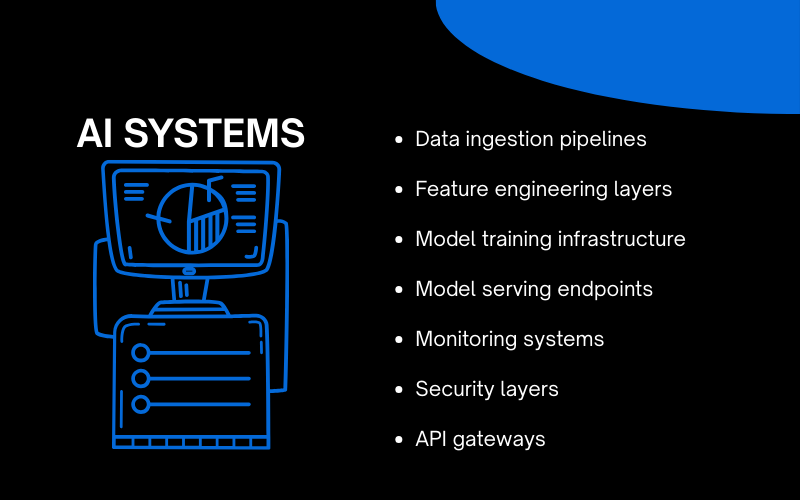
AI systems are more complex than traditional applications because they include:
- Data ingestion pipelines
- Feature engineering layers
- Model training infrastructure
- Model serving endpoints
- Monitoring systems
- Security layers
- API gateways
Trying to combine all that into one codebase is operational chaos.
With Modular services architecture, each component becomes independent, manageable, and scalable.
Benefits include:
- Independent deployment
- Faster updates
- Fault isolation
- Flexible scaling
- Better security control
- Easier compliance management
This is not a trend. It is the enterprise standard.
1. Model-as-a-Service (MaaS) Architecture
One of the most effective microservices patterns for AI is isolating models into dedicated services.
How It Works:
- Each AI model runs as its own microservice
- Exposed through REST or gRPC APIs
- Containerized via Docker or Kubernetes
- Scaled independently based on demand
Instead of embedding models directly into backend systems, they are served through APIs.
Why It Scales
Different AI models have different compute demands.
For example:
- NLP models require high memory
- Vision models require GPU acceleration
- Recommendation systems require fast low-latency inference
By isolating them, enterprises scale each service independently.
Practical Use Case
An e-commerce platform can separate:
- Fraud detection model
- Product recommendation engine
- Customer sentiment analysis
Each becomes a standalone microservices unit.
Strong Opinion:
If your AI models are tightly coupled with backend code, you are building technical debt.
2. Data Pipeline Microservices
AI is only as good as its data.
Instead of one giant ETL pipeline, modern AI platforms use distributed Scalable modular system for data processing.
Architecture Breakdown:
- Data ingestion service
- Data validation service
- Feature extraction service
- Data transformation service
- Storage service
Each pipeline stage runs independently.
Why This Works
- Failures in transformation don’t crash ingestion
- Feature updates don’t affect storage
- New data sources can plug in easily
This modularity ensures agility without system-wide risk.
Example
A financial institution processing millions of transactions daily can isolate:
- Fraud tagging
- Transaction normalization
- Risk scoring
- Reporting feeds
All separate Modular services architecture.
Result? Faster updates. Less downtime.
3. Event-Driven Microservices for Real-Time AI

Real-time AI demands speed and flexibility.
Event-driven architecture combined with Scalable modular system enables dynamic scaling.
How It Works:
- Events are triggered (user action, transaction, sensor data)
- Message broker (Kafka, RabbitMQ) distributes events
- AI Modular services architecture consume relevant events
- Services respond independently
Why It’s Powerful
Instead of polling or synchronous blocking calls, AI services react to events instantly.
This architecture supports:
- Real-time fraud detection
- IoT anomaly monitoring
- Live recommendation engines
- Dynamic pricing systems
Each AI function becomes an event consumer microservice.
Scaling Advantage
High-traffic events scale horizontally without impacting unrelated services.
That’s enterprise-grade resilience.
4. AI Training and Inference Separation Design
One of the biggest mistakes enterprises make is combining model training and inference inside the same system.
They should never share infrastructure.
The Correct Microservices Structure:
Training Scalable modular system
- Data preparation
- Feature engineering
- Model training
- Model validation
- Model registry
Inference Scalable modular system
- API endpoints
- Prediction services
- Response formatting
- Logging
Why Separation Is Critical
Training workloads are:
- Compute-intensive
- GPU-heavy
- Batch-based
Inference workloads are:
- Latency-sensitive
- Real-time
- High-availability focused
If they share infrastructure, performance collapses.
Using Modular services architecture, enterprises isolate workloads and optimize each environment.
This is how mature AI platforms operate.
5. Observability and Monitoring Microservices
AI systems drift. Models degrade. Data shifts.
If you cannot monitor AI performance independently, scaling is dangerous.
Key Monitoring Scalable modular system:
- Model accuracy tracking
- Data drift detection
- Performance metrics
- Bias detection systems
- Alerting services
Each operates separately from the AI models themselves.
Why This Matters
If monitoring lives inside the model service, failures go undetected.
By building dedicated Modular services architecture for observability, enterprises:
- Detect anomalies early
- Trigger retraining workflows
- Maintain compliance standards
- Protect customer trust
Observability is not optional. It is foundational.
Microservices Infrastructure Components for AI
To make these designs work, enterprises must invest in infrastructure discipline.
Key components include:
Containerization
- Docker
- OCI-compatible environments
Orchestration
- Kubernetes
- Auto-scaling clusters
API Management
- Secure gateways
- Rate limiting
- Access control
CI/CD Pipelines
- Independent deployments
- Canary releases
- Automated rollback
This is how AI platforms scale safely.
Common Mistakes in Microservices AI Architecture
Let’s be honest — not all Scalable modular system implementations succeed.
Common failures include:
- Over-fragmentation (too many services too early)
- Poor service communication design
- Lack of centralized logging
- Ignoring API version control
- Weak security between services
Modular services architecture require governance. Discipline beats hype.
When Microservices Are Not Ideal
Traditional wisdom matters.
If your AI system is:
- Small-scale
- Internal-only
- Low traffic
- Proof-of-concept stage
Then monolithic architecture may be sufficient.
But once AI becomes revenue-impacting or mission-critical, Modular services architectureare the only sustainable path.
Scaling without structure is chaos.
Cost Benefits of Microservices in AI
Enterprises often worry that microservices increase cost.
Short-term? Maybe.
Long-term? They reduce cost dramatically.
Why?
- Independent scaling prevents overprovisioning
- Failures don’t crash entire systems
- Teams deploy faster
- Maintenance becomes predictable
- Cloud utilization becomes efficient
Modular services architecture optimize compute allocation instead of forcing uniform scaling.
That’s financial discipline.
Security Advantages of Microservices in AI
Security risk increases with AI adoption.
Modular services architecture strengthen defense by:
- Isolating vulnerabilities
- Enforcing service-level authentication
- Applying zero-trust networking
- Limiting lateral movement
If one AI component fails, the entire platform doesn’t collapse.
That’s enterprise resilience.
The Future: Microservices + AI Agents

AI is moving toward autonomous agents and orchestration systems.
These systems demand:
- Modular architecture
- Service-level autonomy
- API-driven communication
- Independent scaling
Modular services architecture are the only architecture that supports this future.
Enterprises that adopt this structure today will integrate AI agents tomorrow without rebuilding from scratch.
Forward-thinking teams build foundations early.
Final Thoughts
AI scaling is not about bigger models.
It’s about smarter architecture.
Scalable modular system transform AI from experimental projects into stable enterprise infrastructure.
They provide:
- Modularity
- Reliability
- Scalability
- Security
- Cost control
Old-school system discipline still wins.
The companies that respect architecture fundamentals will outperform those chasing shortcuts.
Build Scalable AI Microservices with NKKTech Global
At NKKTech Global, we design and implement enterprise-grade microservices architectures specifically optimized for AI workloads.
We help organizations:
- Break monolithic AI systems into scalable services
- Implement secure API-driven model serving
- Separate training and inference environments
- Build real-time event-driven AI platforms
- Deploy Kubernetes-based AI infrastructure
- Establish monitoring and compliance frameworks
If your AI platform is growing fast but your architecture is not, it’s time to rebuild the foundation properly.
Partner with NKKTech Global today and design microservices architectures that make your AI systems scalable, secure, and future-ready.
Contact Information:
🌎 Website: https://nkk.com.vn
📩 Email: contact@nkk.com.vn
💼 LinkedIn: https://www.linkedin.com/company/nkktech