LLM Latency Optimization is now a top priority for enterprises deploying AI in production environments. Whether it’s AI chatbots, voice assistants, or real-time decision systems, slow response times directly impact user experience, conversion rates, and operational efficiency.
In markets like Australia, Singapore, the United States, and Europe, users expect near-instant responses. A delay of even a few seconds can lead to drop-offs, lower engagement, and reduced trust in AI systems.
This is why understanding LLM Latency Optimization is critical—not just from a technical standpoint, but as a business strategy.
At NKKTech Global, AI engineers design scalable systems where LLM Latency Optimization ensures real-time performance across enterprise applications, from customer support automation to AI call centers.
Why latency matters in enterprise AI systems
Latency defines how quickly an AI system responds after receiving a request. In real-time applications such as voice AI or customer support, latency is directly tied to user satisfaction.
If a chatbot takes too long to respond, users disengage. In voice systems, delays break the natural flow of conversation.
This is where LLM Latency Optimization becomes essential.
Enterprises that invest in reducing latency can:
- Improve customer experience
- Increase conversion rates
- Reduce abandonment rates
- Enable real-time automation
In contrast, poor latency leads to friction, inefficiency, and higher operational costs.
Where latency comes from
Before applying solutions, enterprises must understand the sources of delay.
Common causes include:
- Large model size and heavy computation
- Network delays between systems
- Inefficient prompt structures
- Unoptimized API calls
- Lack of caching mechanisms
Each of these factors contributes to slower response times, making LLM Latency Optimization a multilayer challenge.
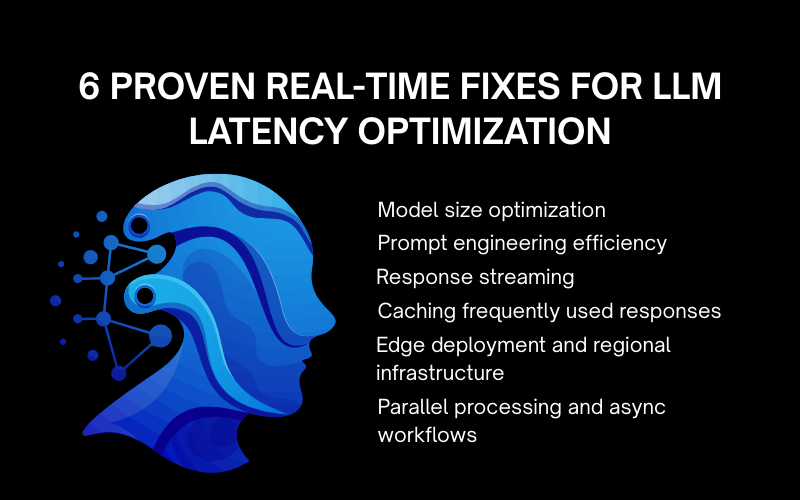
6 proven real-time fixes for LLM latency optimization
Below are six practical techniques used by enterprise AI teams to reduce latency and improve real-time performance.
1. Model size optimization
Larger models typically generate better responses but require more processing time.
One of the most effective LLM Latency Optimization strategies is selecting the right model size for the use case.
Not every application needs the largest model available.
For example:
- Customer FAQs → smaller, faster models
- Complex reasoning → larger models
Using the appropriate model reduces response time without sacrificing quality.
2. Prompt engineering efficiency
Prompt design has a direct impact on latency.
Long, complex prompts increase processing time and token usage.
Optimizing prompts is a key part of LLM Latency Optimization.
Best practices include:
- Keeping prompts concise
- Removing unnecessary instructions
- Structuring inputs clearly
Efficient prompts lead to faster inference and lower costs.
3. Response streaming
Instead of waiting for the full response, streaming allows AI systems to send outputs in real time as they are generated.
This technique significantly improves perceived speed.
For voice AI and chat systems, streaming is one of the most impactful LLM Latency Optimization methods.
Users experience faster interactions even if total processing time remains similar.
4. Caching frequently used responses
Many AI applications handle repetitive queries.
Caching allows systems to store and reuse responses for common requests.
This reduces the need for repeated model inference.
Caching is a simple but powerful LLM Latency Optimization technique, especially in customer support environments.
5. Edge deployment and regional infrastructure
Latency is heavily influenced by physical distance between users and servers.
Deploying AI systems closer to users reduces network delays.
For companies targeting Australia or Singapore, regional infrastructure is critical.
This approach is a core part of LLM Latency Optimization for global applications.
Using edge computing or region-based cloud deployment ensures faster response times.
6. Parallel processing and async workflows
Instead of processing tasks sequentially, enterprises can run operations in parallel.
For example:
- Fetching customer data
- Running intent detection
- Preparing responses
All at the same time.
Parallel execution significantly reduces total response time and is a key LLM Latency Optimization strategy in enterprise systems.
Real-world impact of LLM latency optimization
Companies that successfully implement LLM Latency Optimization see measurable improvements.
These include:
- Faster customer interactions
- Higher engagement rates
- Improved AI adoption internally
- Reduced infrastructure costs
In AI call centers, reducing latency creates more natural conversations.
In chatbots, it increases session duration and conversion rates.
For global businesses, LLM Latency Optimization is not optional—it is a competitive advantage.
LLM latency optimization in voice AI systems
Latency is even more critical in voice applications.
Unlike text-based systems, voice conversations require near real-time responses to feel natural.
A delay of more than 1–2 seconds can disrupt the interaction.
This makes LLM Latency Optimization essential for:
- AI call centers
- Voice assistants
- Automated booking systems
At NKKTech Global, voice AI systems are designed with low-latency pipelines that integrate speech recognition, language models, and response generation seamlessly.
Building scalable low-latency AI systems
To achieve effective LLM Latency Optimization, enterprises must design systems holistically.
Key components include:
- Optimized model selection
- Efficient API architecture
- Real-time data processing pipelines
- Smart caching layers
- Scalable cloud infrastructure
These elements work together to ensure consistent performance across different markets.
For businesses operating in multiple regions, maintaining low latency across all users is a major challenge.
Future trends in LLM latency optimization
As AI technology evolves, new approaches to LLM Latency Optimization are emerging.
These include:
- Smaller, more efficient model architectures
- On-device AI processing
- Advanced hardware acceleration
- Improved model compression techniques
These innovations will allow enterprises to deliver faster AI experiences at lower cost.
Conclusion
AI systems are only as effective as their ability to respond in real time.
Slow responses reduce engagement, increase frustration, and limit the value of automation.
By implementing proven techniques such as model optimization, caching, streaming, and edge deployment, organizations can significantly improve performance.
Understanding LLM Latency Optimization enables enterprises to build AI systems that are not only intelligent but also fast and reliable.
Build low-latency AI systems with NKKTech Global
At NKKTech Global, we specialize in designing high-performance AI systems for enterprise use.
Our engineering teams implement advanced LLM Latency Optimization strategies to ensure real-time responsiveness across:
- AI chatbots
- Voice AI platforms
- AI call centers
- Enterprise automation systems
If your organization is looking to improve AI performance and reduce response times, NKKTech Global can help you build scalable, low-latency solutions.
Contact NKKTech Global today to start optimizing your AI systems for real-time performance
Contact Information:
🌎 Website: https://nkk.com.vn
📩 Email: contact@nkk.com.vn
💼 LinkedIn: https://www.linkedin.com/company/nkktech