Let’s be honest. Most chatbots fail quietly.
They launch with excitement. They answer a few scripted questions well. Then real users show up. Language becomes messy. Questions become unpredictable. Expectations become higher. And suddenly, the chatbot feels robotic, inaccurate, or worse — irrelevant.
The difference between a mediocre bot and a reliable one is not design. It is not UI. It is not even the AI model itself.
It is AI Training.
At NKKTech Global, we approach AI Training as a disciplined engineering process, not a checkbox step before launch. If your organization wants chatbots that customers trust and employees rely on, these seven AI Training steps are non-negotiable.
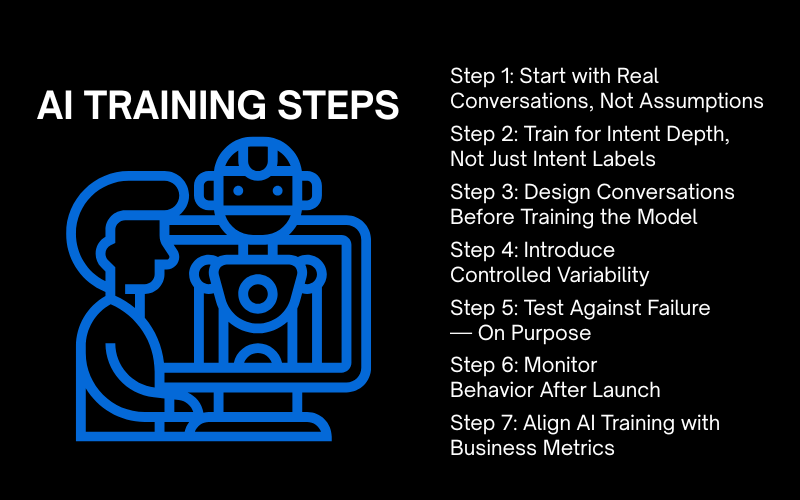
Step 1: Start with Real Conversations, Not Assumptions
Too many teams begin AI Training using imagined questions.
That is the first mistake.
Reliable AI Training starts with real data:
- Customer support transcripts
- Sales chat logs
- Email inquiries
- Call center summaries
- FAQ search queries
When AI Training is based on actual language patterns, the chatbot learns how people truly communicate — including incomplete sentences, slang, and emotional phrasing.
If your dataset is artificial, your chatbot will sound artificial.
Step 2: Train for Intent Depth, Not Just Intent Labels
Many teams believe AI Training is about teaching the bot to recognize “billing,” “pricing,” or “support.”
That’s surface-level thinking.
Effective AI Training builds intent layers:
- Primary intent (What does the user want?)
- Contextual intent (Why do they want it?)
- Urgency level (How critical is it?)
- Emotional tone (Are they frustrated?)
A reliable chatbot does not just classify. It understands nuance.
At NKKTech Global, our AI Training frameworks include contextual tagging so enterprise bots can respond intelligently, not mechanically.
Step 3: Design Conversations Before Training the Model
Here’s something most companies skip: conversation architecture.
Before AI Training begins, map:
- Entry points
- Decision trees
- Escalation triggers
- Data capture moments
- Exit conditions
AI Training works best when the chatbot’s conversation logic is clearly structured. Otherwise, the model learns patterns that lead to dead ends.
Training without conversational design is like teaching someone to speak without teaching them how to hold a conversation.
Step 4: Introduce Controlled Variability
If you only train the chatbot on perfect sentences, it will fail in real life.
Strong AI Training includes variability:
- Misspellings
- Abbreviations
- Short fragments
- Multilingual code-switching
- Regional phrasing
For companies operating in markets like Singapore or Australia, AI Training must account for linguistic diversity.
At NKKTech Global, we deliberately stress-test AI Training models with messy language to ensure resilience under real conditions.
Step 5: Test Against Failure — On Purpose
Most teams test chatbots to prove they work.
High-performing teams test chatbots to make them fail.
During AI Training validation, ask:
- What questions break intent detection?
- Where does context get lost?
- When does escalation misfire?
- How often does fallback trigger unnecessarily?
Reliable AI Training is strengthened by controlled failure. Each failure reveals a data gap.
A chatbot becomes reliable not because it avoids mistakes — but because AI Training continuously eliminates them.
Step 6: Monitor Behavior After Launch
Here’s the truth: AI Training does not end at deployment.
Once users begin interacting, new patterns appear:
- Unexpected objections
- Emerging product questions
- Policy updates
- Seasonal trends
Live interaction data becomes the most valuable AI Training resource.
Organizations that ignore post-launch AI Training updates see chatbot performance decline within months.
At NKKTech Global, we implement continuous AI Training loops so enterprise chatbots improve over time instead of degrading.
Step 7: Align AI Training with Business Metrics
A chatbot can be technically accurate and still fail the business.
AI Training must connect to:
- Conversion rates
- Resolution time
- Escalation cost
- Customer satisfaction
- Lead quality
For example, if a sales chatbot recognizes pricing questions correctly but fails to guide users toward booking a demo, the AI Training objective is incomplete.
Reliable AI Training aligns conversational intelligence with measurable outcomes.
What Reliable Chatbots Actually Feel Like
When AI Training is done properly, users notice:
- Responses feel natural.
- The bot remembers context.
- Questions are understood quickly.
- Escalations happen smoothly.
- Interactions save time instead of wasting it.
That is the difference between automation and intelligence.
The Hidden Cost of Weak AI Training
Poor AI Training leads to:
- High fallback rates
- Increased human intervention
- Customer frustration
- Brand damage
- Lost sales opportunities
In enterprise environments, even a 5% drop in chatbot accuracy can translate into thousands of dollars in lost revenue or increased operational cost.
Reliable AI Training is not an expense. It is risk management.
Enterprise Perspective: Why Structure Wins

Large organizations operate across:
- Multiple departments
- Multiple markets
- Multiple compliance environments
AI Training in this context must include:
- Data governance protocols
- Version control for model updates
- Security validation
- Integration testing with CRM and ERP systems
This is where many chatbot initiatives stall — not because the AI is weak, but because the AI Training process lacks structure.
At NKKTech Global, we build enterprise AI Training ecosystems that integrate seamlessly with business infrastructure.
The Future of AI Training for Chatbots
Looking ahead, AI Training will increasingly incorporate:
- Reinforcement learning from user feedback
- Hybrid rule-based and generative systems
- Real-time knowledge base synchronization
- Emotion-aware response modeling
Reliable chatbots will not simply answer questions — they will adapt dynamically to user behavior.
But none of that works without disciplined AI Training foundations.
Conclusion
Chatbots are easy to launch. Reliable chatbots are engineered.
If your chatbot feels rigid, repetitive, or inaccurate, the issue is not the interface — it is the AI Training strategy behind it.
When AI Training is structured, contextual, continuously optimized, and aligned with business metrics, chatbots become trusted digital assets rather than experimental tools.
Build Reliable AI Systems with NKKTech Global
At NKKTech Global, we design enterprise-grade AI Training frameworks that power high-performance chatbots.
We help organizations:
- Structure conversational architectures
- Build clean and scalable training datasets
- Implement secure AI Training pipelines
- Monitor performance with real-time analytics
- Continuously optimize chatbot intelligence
If you are ready to move from basic automation to truly reliable conversational AI, now is the time.
Contact NKKTech Global today to build chatbots powered by strategic, enterprise-level AI Training.
Contact Information:
🌎Website: https://nkk.com.vn
📩Email: contact@nkk.com.vn
💼LinkedIn: https://www.linkedin.com/company/nkktech