Artificial intelligence adoption is accelerating across Japan. From manufacturing and finance to retail and healthcare, AI systems are moving into core business operations. But innovation without regulation alignment creates risk. That is why AI compliance JP has become a top priority for enterprise leaders in 2025.
Japan maintains strict data governance standards, consumer protection expectations, and corporate accountability frameworks. Enterprises deploying AI must align technology with legal, ethical, and operational safeguards.
At NKKTech Global, we support Japanese enterprises in building AI systems that are both innovative and compliant. Below are six essential AI compliance JP rules that every enterprise should implement.
Why AI Compliance JP Matters Now
AI is no longer limited to experimentation. It influences:
- Credit decisions
- Hiring processes
- Customer interactions
- Supply chain automation
- Fraud detection systems
With such impact comes responsibility. AI policy governance JP frameworks are necessary to ensure:
- Transparency in decision-making
- Protection of personal data
- Fair and unbiased algorithms
- Security of enterprise systems
- Accountability in automated outcomes
Ignoring compliance risks legal penalties, reputational damage, and operational disruption.
1. Ensure Data Privacy Alignment with APPI
Japan’s Act on the Protection of Personal Information (APPI) sets strict standards for handling personal data.
AI compliance JP begins with:
- Clear consent mechanisms
- Data minimization principles
- Secure storage and encryption
- Defined data retention policies
- Cross-border transfer controls
AI models often require large datasets. Enterprises must ensure that personal information is processed legally and securely.
At NKKTech Global, we embed APPI-aligned governance into AI architecture design to ensure AI compliance JP from the foundation.
Risk of Non-Compliance:
- Regulatory fines
- Legal disputes
- Customer trust erosion
2. Maintain Algorithmic Transparency and Explainability

Japanese enterprises place strong emphasis on accountability. If an AI system influences decisions, organizations must explain how those decisions were made.
AI compliance JP requires:
- Documented model logic
- Clear decision criteria
- Human oversight checkpoints
- Audit trails for automated actions
This is especially critical in sectors such as finance, insurance, and HR.
Black-box AI systems increase compliance exposure. Enterprises must prioritize explainable AI (XAI) frameworks as part of AI compliance JP strategy.
3. Implement Bias Detection and Fairness Controls
AI models trained on biased data can produce discriminatory outcomes.
AI compliance JP standards increasingly emphasize:
- Bias testing during model development
- Dataset diversity validation
- Continuous monitoring for unfair patterns
- Regular re-evaluation of outputs
For example, AI systems used in recruitment or credit assessment must ensure fair treatment across demographics.
At NKKTech Global, fairness audits are integrated into AI development cycles to strengthen AI compliance JP resilience.
Why It Matters:
- Protects brand reputation
- Avoids discrimination claims
- Supports ethical corporate governance
4. Establish Human Oversight Mechanisms
Automation does not remove responsibility. Enterprises remain accountable for AI-driven outcomes.
AI regulatory standards JP requires:
- Clear human-in-the-loop processes
- Escalation pathways for complex cases
- Defined override capabilities
- Internal governance committees
For mission-critical systems, AI decisions should be reviewable and reversible.
Organizations that implement strong oversight demonstrate regulatory maturity and strengthen AI compliance JP credibility.
5. Secure AI Infrastructure Against Cyber Threats
AI systems introduce new attack surfaces.
Threats include:
- Data poisoning
- Model manipulation
- Unauthorized API access
- Inference-based attacks
AI compliance JP includes cybersecurity safeguards such as:
- Encrypted training pipelines
- Access control frameworks
- Continuous vulnerability assessments
- Secure API management
Without infrastructure security, compliance cannot be guaranteed.
NKKTech Global integrates AI security architecture as a core component of AI regulatory standards JP implementation.
6. Maintain Continuous Monitoring and Regulatory Adaptation
Regulatory frameworks evolve. AI compliance JP is not static.
Enterprises must implement:
- Periodic compliance audits
- Regulatory watch processes
- Model retraining documentation
- Internal compliance reporting systems
AI systems that are compliant at launch may drift into non-compliance without monitoring.
Continuous governance ensures long-term stability and reduces risk exposure.
How AI Compliance JP Supports Business Growth
Compliance is often viewed as a constraint. In reality, it is a strategic enabler.
Strong AI regulatory standards frameworks:
- Increase customer trust
- Strengthen investor confidence
- Support cross-border expansion
- Reduce operational risk
- Enable scalable AI deployment
Enterprises that prioritize compliance early avoid costly retrofits later.
Common AI Compliance JP Mistakes
Even mature organizations make errors such as:
- Treating compliance as a legal afterthought
- Deploying AI tools without documentation
- Ignoring third-party vendor risk
- Overlooking internal employee training
- Failing to monitor model drift
AI compliance JP requires cross-functional coordination between IT, legal, operations, and executive leadership.
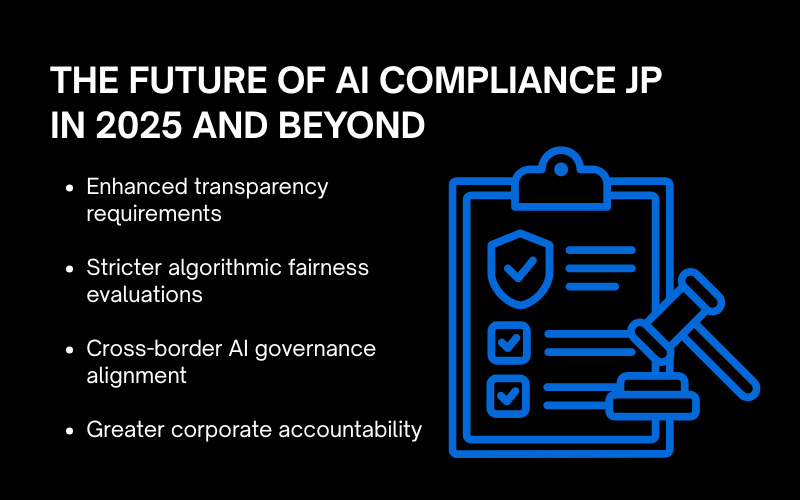
The Future of AI Compliance JP in 2025 and Beyond
Japan continues to align with global AI governance trends while maintaining domestic standards.
Future AI compliance JP focus areas will likely include:
- Enhanced transparency requirements
- Stricter algorithmic fairness evaluations
- Cross-border AI governance alignment
- Greater corporate accountability
Enterprises that build structured compliance frameworks today will adapt faster to regulatory evolution.
Final Thoughts
AI innovation without compliance creates exposure. Sustainable AI growth requires discipline.
AI compliance JP is not just about avoiding penalties. It is about building responsible systems that customers, regulators, and partners can trust.
For Japanese enterprises, aligning AI strategy with governance principles ensures long-term competitiveness.
Organizations that treat AI regulatory standards JP as a strategic pillar will lead in both innovation and credibility.
Strengthen AI Compliance JP with NKKTech Global
At NKKTech Global, we design AI systems that meet Japan’s regulatory standards while enabling scalable innovation.
We help enterprises:
- Align AI architecture with APPI requirements
- Implement explainable AI frameworks
- Conduct bias audits and fairness testing
- Secure AI infrastructure
- Establish governance and monitoring processes
If your organization is expanding AI capabilities, compliance must move at the same pace.
Contact NKKTech Global today to build secure, compliant, and future-ready AI systems aligned with AI compliance JP standards
Contact Information:
🌎 Website: https://nkk.com.vn
📩 Email: contact@nkk.com.vn
💼 LinkedIn: https://www.linkedin.com/company/nkktech