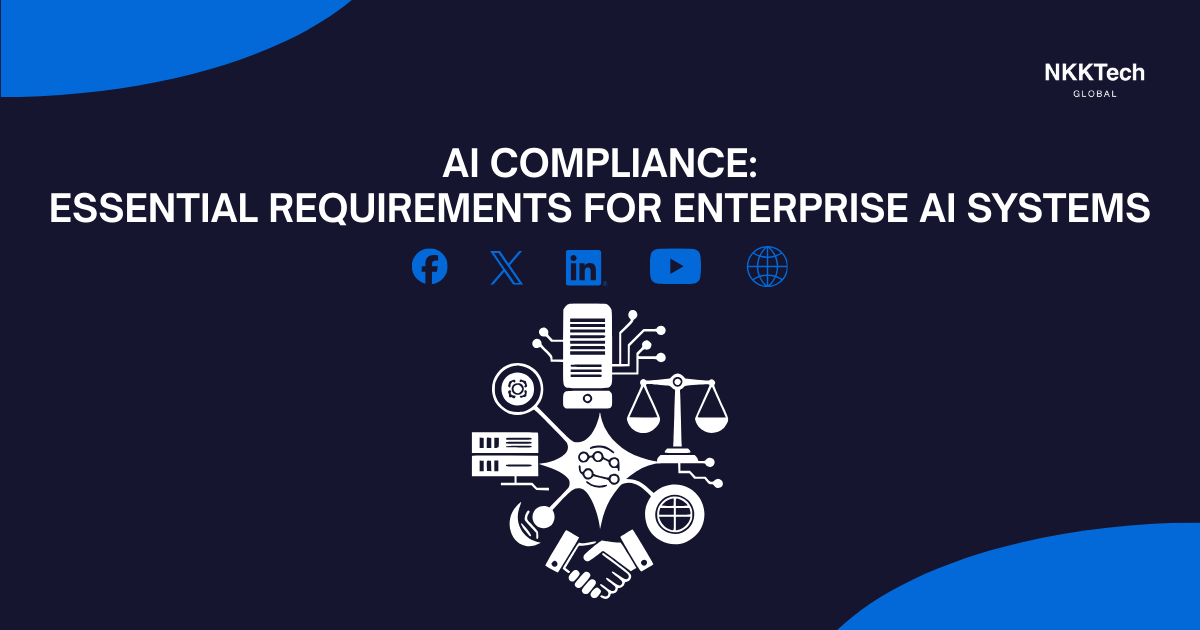
AI compliance has become a critical requirement for enterprises deploying AI systems in real-world operations. As AI moves from experimentation to production, organizations must ensure their AI systems are compliant, reliable, transparent, and aligned with regulatory expectations from day one.
At NKKTech Global, AI compliance is treated as a foundational part of enterprise AI architecture—designed to support long-term scalability, operational stability, and business trust.
Why AI Compliance Matters for Enterprise AI Systems
AI compliance is no longer a legal afterthought. It directly impacts how AI systems behave in production, how risks are managed, and how confidently organizations can scale AI across departments.
For enterprise leaders, the biggest concerns include:
- Regulatory exposure across different markets
- Uncontrolled AI outputs and hallucinations
- Lack of explainability in AI-driven decisions
- Data privacy and security risks
AI compliance ensures that AI systems remain predictable, auditable, and safe to operate at scale.
Regulatory Readiness and AI Governance
Enterprise AI systems must align with evolving regulations, internal governance policies, and industry standards. This requires clearly defined ownership of AI decisions, approval workflows, and escalation paths.
At NKKTech Global, governance is built directly into the AI system through access controls, logging mechanisms, and structured review processes—ensuring compliance without slowing innovation.
Managing Operational Risk in Production AI
Without proper compliance controls, AI systems can create costly operational failures. AI compliance enables enterprises to define acceptable error thresholds, establish fallback logic, and implement human-in-the-loop workflows for high-risk scenarios.
This approach reduces uncertainty and increases confidence when deploying AI in critical business processes.
Core AI Compliance Requirements in Production Environments
As AI systems move from experimentation to real-world deployment, AI compliance becomes a foundational requirement rather than an optional consideration. In production environments, AI models directly impact customers, business decisions, and operational stability. Without clear compliance controls, even technically strong AI systems can introduce legal, security, and reputational risks.
Data Governance and Privacy Protection
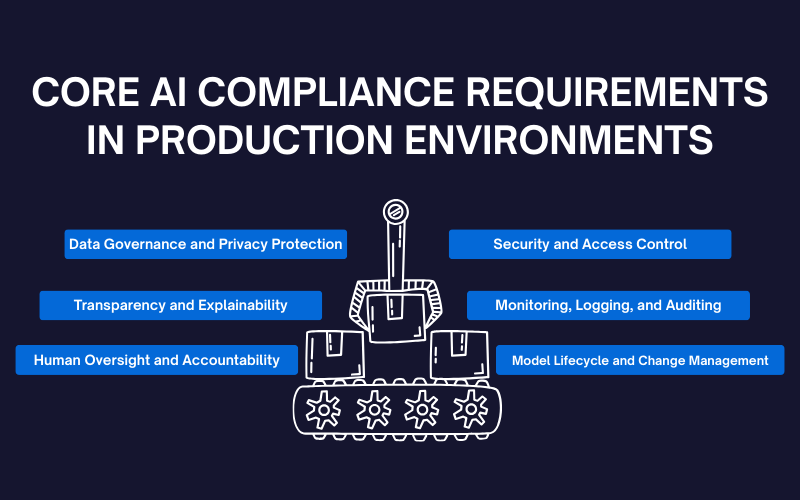
One of the most critical compliance requirements is data governance. Production AI systems often process sensitive data such as personal information, financial records, or internal business documents. Organizations must ensure strict controls over data collection, storage, access, and retention. Compliance with regulations such as GDPR, HIPAA, or regional data protection laws requires clear data boundaries, access logging, and defined data lifecycle policies.
Transparency and Explainability
In production, AI decisions must be explainable to stakeholders, auditors, and sometimes regulators. This does not necessarily mean exposing model internals, but organizations should be able to explain why an AI system produced a certain output, what data sources were used, and which rules or constraints applied. Transparency is essential for building trust, especially in customer-facing or decision-support systems.
Human Oversight and Accountability
AI systems should not operate as fully autonomous black boxes in high-impact scenarios. Clear human-in-the-loop or human-on-the-loop mechanisms are required to review, override, or audit AI outputs. From a compliance standpoint, accountability must always remain with human operators or business owners, not with the model itself.
Security and Access Control
Production AI systems must follow enterprise-grade security standards. This includes authentication, role-based access control, prompt and output filtering, and protection against prompt injection or data leakage. Compliance also requires regular security reviews and incident response plans tailored to AI-specific risks.
Monitoring, Logging, and Auditing
Continuous monitoring is a core compliance requirement. Organizations must log AI inputs, outputs, model versions, and configuration changes to enable traceability and post-incident analysis. These logs are essential for audits, debugging, and regulatory reporting.
Model Lifecycle and Change Management
Any update to a model, prompt, or retrieval pipeline should follow controlled deployment processes. Versioning, approval workflows, rollback mechanisms, and impact assessments help ensure that changes do not introduce unexpected behavior in production.
In summary, AI compliance in production is about control, accountability, and trust. Organizations that embed compliance into system design from day one can scale AI safely while meeting regulatory and enterprise expectations..
How NKKTech Global Implements AI Compliance for Enterprises
AI compliance should enable progress, not create friction. Our approach focuses on embedding compliance into scalable system architecture.
Compliance-by-Design Architecture
We integrate compliance requirements across every layer of the system—from data ingestion and AI inference to APIs and user interfaces—ensuring consistency as systems grow.
Human-in-the-Loop and Failure Handling
Not all AI decisions should be fully automated. NKKTech Global designs AI systems with structured human review processes, confidence-based escalation, and safe fallback mechanisms to minimize operational risk.
AI Compliance as a Competitive Advantage
Enterprises that prioritize AI compliance early gain faster internal approvals, higher user trust, and smoother scaling across regions and use cases.
Building Trustworthy AI Starts with Compliance
AI compliance is no longer a checkbox at the end of deployment—it is the foundation of trustworthy, scalable enterprise AI. In real-world production environments, compliance determines whether AI systems can operate safely, earn user trust, and adapt to regulatory change without disrupting business operations. Enterprises that embed compliance into architecture, governance, and operational workflows from the beginning are better positioned to scale AI with confidence.
At NKKTech Global, we view AI compliance as a strategic enabler rather than a constraint. By combining governance, transparency, human oversight, and continuous monitoring, enterprises can deploy AI systems that are not only powerful, but also predictable, auditable, and resilient in production.
Ready to build compliant, production-ready AI systems?
Connect with NKKTech Global to explore a long-term partnership in designing enterprise AI solutions that meet regulatory expectations while driving real business impact.
Contact Information:
🌎 Website: https://nkk.com.vn
📩 Email: contact@nkk.com.vn
📌 LinkedIn: https://www.linkedin.com/company/nkktech