AI call transcription accuracy is one of the most critical factors in modern voice AI systems. As enterprises across Australia, Singapore, the United States, and Europe adopt AI-powered call centers, the ability to accurately transcribe speech directly impacts customer experience, analytics quality, and automation success.
In real-world environments, conversations are messy. Customers speak with different accents, interrupt themselves, use informal language, and often call from noisy environments. Without strong AI call transcription accuracy, downstream systems such as intent detection, CRM updates, and automation workflows begin to fail.
For enterprises deploying voice AI at scale, improving AI call transcription accuracy is not just a technical upgrade—it is a foundational requirement for reliable AI communication.
At NKKTech Global, voice AI platforms are engineered to deliver high AI call transcription accuracy across diverse markets, enabling businesses to operate scalable, intelligent call center systems.
Why transcription accuracy matters in enterprise AI calls
Every AI-powered call begins with speech recognition. If the transcription layer fails, everything built on top of it becomes unreliable.
Poor AI call transcription accuracy leads to the following:
- Misinterpreted customer intent
- Incorrect automation actions
- Frustrating customer experiences
- Inaccurate analytics and reporting
For example, if a customer says the following:
“I want to reschedule my appointment.”
But the system transcribes it incorrectly, the AI may trigger the wrong workflow.
This shows why AI call transcription accuracy directly affects both customer satisfaction and operational efficiency.
Real-world challenges affecting AI call transcription accuracy
Unlike controlled testing environments, production systems must handle unpredictable inputs.
Enterprises commonly face the following challenges:
Accent diversity
Customers in global markets speak with a wide range of accents. Systems trained on limited datasets struggle to generalize.
Background noise
Call environments often include traffic noise, office chatter, or poor signal quality.
Speech variations
Customers pause, repeat themselves, or change sentences mid-way.
Domain-specific vocabulary
Industry-specific terms (finance, healthcare, logistics) are often misrecognized.
These challenges make improving AI call transcription accuracy a complex engineering task.
6 production fixes to improve AI call transcription accuracy
Below are six proven techniques used by enterprises to improve transcription performance in real-world environments.
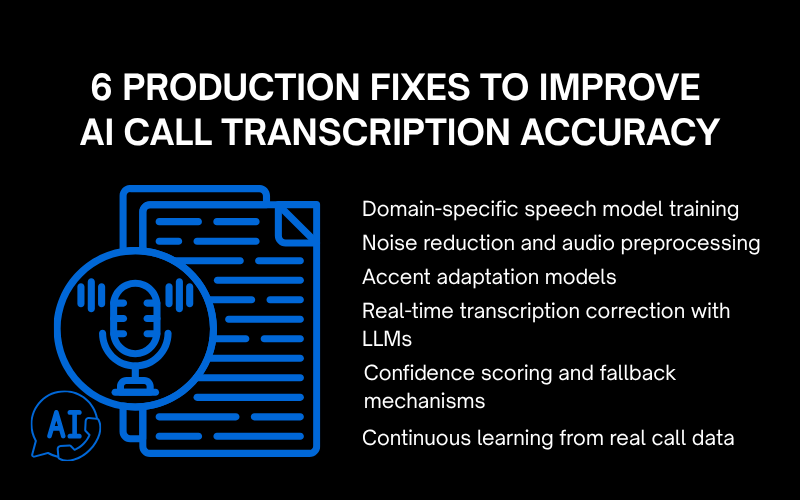
1. Domain-specific speech model training
Generic speech recognition models often fail to recognize industry-specific terms.
One of the most effective ways to improve AI call transcription accuracy is training models using domain-specific datasets.
For example:
- Healthcare systems → medical terminology
- Finance platforms → transaction and account-related terms
- E-commerce → product names and order flows
By adapting models to specific use cases, enterprises can significantly improve transcription quality.
2. Noise reduction and audio preprocessing
Audio quality has a direct impact on transcription performance.
Before speech is processed, systems can apply noise reduction techniques such as:
- Background noise filtering
- Echo cancellation
- Volume normalization
These preprocessing steps enhance input quality and improve AI call transcription accuracy in noisy environments.
This is particularly important for global call centers where customers call from various conditions.
3. Accent adaptation models
Global businesses must handle diverse accents across regions.
Accent adaptation is a key strategy for improving AI call transcription accuracy.
This can be achieved by:
- Training models on multi-accent datasets
- Using region-specific speech models
- Continuously updating models with real call data
For companies targeting markets like Australia or Singapore, accent coverage is critical for maintaining accuracy.
4. Real-time transcription correction with LLMs
Modern AI systems combine speech recognition with large language models to improve output quality.
LLMs can correct transcription errors by analyzing context.
For example:
Raw transcription:
“I need to check my balance.”
Corrected output:
“I need to check my balance.”
This hybrid approach significantly improves AI call transcription accuracy, especially in complex conversations.
5. Confidence scoring and fallback mechanisms
Not all transcriptions are equally reliable.
Enterprise systems assign confidence scores to each transcription result.
When confidence is low, the system can:
- Ask the user to repeat
- Confirm the request
- Transfer to a human agent
This approach prevents erroneous automation and improves overall AI call-transcription accuracy in production systems.
6. Continuous learning from real call data
The most effective way to improve transcription performance is through continuous learning.
By analyzing real conversations, organizations can identify:
- Common misinterpretations
- Frequently used phrases
- New vocabulary
These insights are used to retrain models and refine systems.
Continuous improvement ensures that AI call transcription accuracy increases over time.
At NKKTech Global, voice AI systems include analytics pipelines that enable ongoing optimization based on real-world usage.
Technology stack behind transcription accuracy
Achieving high AI call transcription accuracy requires a combination of technologies.
Key components include:
- Speech-to-text engines
- Acoustic modeling
- Language modeling
- Noise filtering systems
- Context-aware correction models
These components must work together seamlessly to produce reliable transcriptions.
Integration with CRM systems and automation workflows ensures that accurate data leads to correct business actions.
Impact on enterprise performance
Improving AI call transcription accuracy delivers measurable business benefits.
These include:
- Higher automation success rates
- Reduced need for human intervention
- Better customer experience
- More accurate analytics
For global enterprises, transcription accuracy also enables consistent service quality across different regions and languages.
Organizations that prioritize AI call transcription accuracy can scale their voice AI systems more effectively.
Transcription accuracy in voice AI ecosystems
Transcription is not a standalone function. It plays a central role in the entire voice AI pipeline.
Accurate transcription improves:
- Intent recognition
- Conversation flow
- Response generation
- Customer insights
Without strong AI call transcription accuracy, even advanced AI systems struggle to deliver reliable performance.
Future trends in AI call transcription accuracy
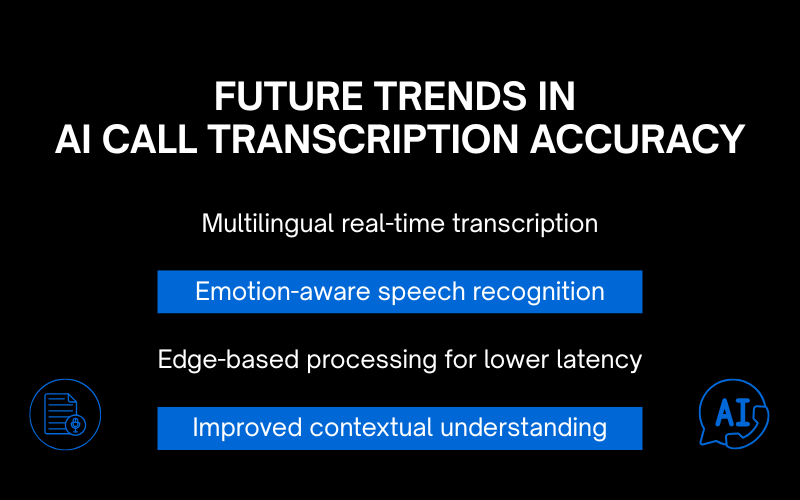
Speech recognition technology continues to evolve.
Future developments include:
- Multilingual real-time transcription
- Emotion-aware speech recognition
- Edge-based processing for lower latency
- Improved contextual understanding
These innovations will further enhance AI call transcription accuracy and enable more advanced voice AI applications.
Conclusion
Voice AI systems are transforming how enterprises manage customer communication.
However, their success depends heavily on the ability to accurately understand spoken language.
Improving AI call transcription accuracy ensures that AI systems can interpret customer requests correctly, trigger the right workflows, and deliver seamless experiences.
From domain-specific training to real-time correction and continuous learning, enterprises have multiple strategies to enhance transcription performance.
For organizations operating in global markets, investing in AI call transcription accuracy is essential for building reliable and scalable AI communication systems.
Build high-accuracy voice AI systems with NKKTech Global
At NKKTech Global, we specialize in building enterprise voice AI platforms that deliver high AI call transcription accuracy in real-world environments.
Our solutions integrate speech recognition, language models, and intelligent automation to create scalable communication systems for global businesses.
Whether you are developing AI call centers, voice assistants, or automated support platforms, our team can help you design systems that perform reliably at scale.
Contact NKKTech Global today to build AI solutions with industry-leading transcription accuracy.
Contact Information:
🌎 Website: https://nkk.com.vn
📩 Email: contact@nkk.com.vn
💼 LinkedIn: https://www.linkedin.com/company/nkktech