Table of Contents
Customer service operations are under increasing pressure worldwide. Companies serving customers across regions such as Australia, Singapore, the United States, and Europe are facing higher service expectations, increasing call volumes, and rising operational costs.
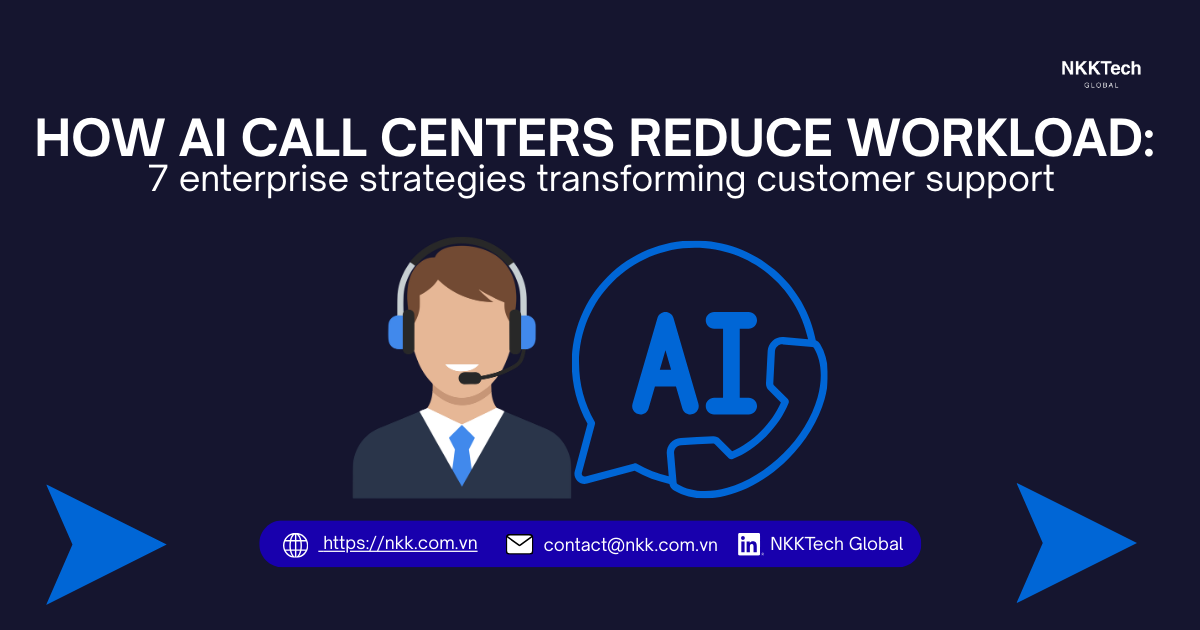
In this environment, many organizations are turning to artificial intelligence to modernize their support systems. A key question business leaders often ask is how AI call centers reduce workload while still maintaining high service quality.
AI-powered call centers combine technologies such as speech recognition, natural language processing, and intelligent automation to handle customer interactions more efficiently. These systems can respond instantly, route requests automatically, and assist human agents with real-time insights.
Understanding how AI call centers reduce workload is particularly important for enterprises operating across multiple markets, where customer demand is constant and support teams must handle thousands of daily interactions.
Companies that successfully implement AI-driven communication systems can significantly improve efficiency while delivering faster and more reliable customer experiences.
The growing pressure on enterprise customer support teams

Customer service teams around the world are dealing with several major challenges. One of the biggest issues is the sheer volume of incoming calls. Customers expect quick answers to questions related to orders, billing, subscriptions, or technical issues.
Traditional call centers rely heavily on human agents to manage these conversations. However, scaling human teams is expensive and often inefficient. Recruitment, training, and operational management require significant investment.
Another issue is that a large percentage of customer inquiries are repetitive. Simple questions such as checking delivery status or scheduling appointments consume valuable agent time.
This is where businesses begin to explore how AI call centers reduce workload by automating routine interactions and optimizing how support teams operate.
For global companies serving customers across time zones, AI systems also provide a way to offer 24/7 support without dramatically increasing staffing costs.
Why enterprises are adopting AI call center automation
Organizations adopting voice automation quickly recognize how AI call centers reduce workload through multiple operational improvements.
AI systems can instantly analyze incoming calls, detect the intent of the customer, and trigger automated workflows. This allows many common requests to be handled without human involvement.
For companies operating in competitive markets such as the United States or Singapore, faster response times can significantly improve customer satisfaction.
Businesses in Australia and Europe are also adopting AI call center technologies to maintain consistent service quality across distributed teams.
Understanding how AI call centers reduce workload helps enterprises design support systems that scale efficiently as their customer base grows.
Seven enterprise ways AI call centers reduce workload
The impact of voice AI becomes clear when examining specific operational improvements. Below are seven ways organizations are applying automation to reduce pressure on support teams.
Automating repetitive customer inquiries
A large portion of incoming customer calls involves simple questions. Customers frequently ask about order status, account information, or store hours.
Automated voice systems can answer these requests instantly using real-time data integration.
When organizations automate these repetitive interactions, they quickly see how AI call centers reduce workload by freeing human agents from routine tasks.
Instead of answering the same questions repeatedly, agents can focus on more complex customer issues that require problem-solving and empathy.
For enterprises handling thousands of calls per day, this change alone can dramatically improve productivity.
Intelligent call routing
Another critical factor in how AI call centers reduce workload is intelligent call routing.
Traditional call centers often rely on basic menu systems that route customers through long and confusing phone trees. This approach can lead to misrouted calls and frustrated customers.
AI-powered systems analyze the caller’s request using natural language processing. The system then routes the call directly to the most appropriate department or specialist.
By reducing unnecessary transfers, intelligent routing saves time for both customers and support agents.
Organizations implementing AI-driven routing often see faster resolution times and improved customer satisfaction.
Automated appointment scheduling
Many industries rely heavily on scheduling calls. Healthcare providers, service companies, financial advisors, and logistics firms frequently manage appointment bookings through their call centers.
AI voice systems can automate this process entirely.
Customers can speak naturally to the system to schedule, modify, or cancel appointments.
This is another clear example of how AI call centers reduce workload because scheduling tasks often require significant administrative effort.
Automation eliminates the need for agents to manually check calendars and confirm bookings.
Proactive customer notifications
Another important strategy demonstrating how AI call centers reduce workload is proactive communication.
AI systems can automatically notify customers about important updates such as delivery changes, service disruptions, or appointment reminders.
By sending automated voice calls or messages before customers need to contact support, businesses can reduce inbound call volume.
This approach is particularly effective for companies managing logistics, utilities, or subscription services.
Customers receive timely updates, while support teams experience fewer incoming requests.
Real-time agent assistance
AI call center systems are not only designed to interact with customers directly. They can also function as intelligent assistants for human agents.
During live calls, AI tools can analyze conversations and provide suggestions in real time.
For example, the system might recommend relevant knowledge base articles or display customer history automatically.
This type of support is another example of how AI call centers reduce workload, because agents spend less time searching for information.
Instead, they can respond quickly with accurate answers.
Automated call summaries and CRM updates
After each customer interaction, agents typically need to document the conversation in a CRM system. This administrative work can take several minutes per call.
AI systems can automatically generate structured summaries of conversations and update customer records.
Automated documentation reduces manual effort while improving data accuracy.
Companies implementing these tools clearly see how AI call centers reduce workload by minimizing post-call administrative tasks.
Scalable support during peak demand
Seasonal demand spikes are common in many industries.
Retail businesses experience heavy traffic during holidays, while travel companies see spikes during vacation periods.
Hiring and training temporary agents is expensive and time-consuming.
AI-powered platforms provide flexible capacity, allowing organizations to scale support operations instantly.
This scalability highlights another major advantage of how AI call centers reduce workload, especially for companies operating in global markets.
Technology behind AI call center automation
Understanding how AI call centers reduce workload also requires examining the technology stack powering these systems.
Modern AI call centers combine several key technologies.
Speech recognition converts spoken language into text so that AI systems can process customer requests.
Natural language understanding models analyze the meaning behind these requests and identify customer intent.
Dialogue management systems determine how the AI should respond and which workflows should be triggered.
Backend integrations connect AI platforms with CRM systems, databases, and scheduling tools.
Finally, speech synthesis converts AI-generated responses back into natural-sounding speech.
Together, these technologies create intelligent communication platforms capable of handling large volumes of interactions automatically.
Why global markets are investing in AI call centers

Organizations across regions such as Australia, Singapore, the United States, and Europe are rapidly adopting voice AI solutions.
Several factors are driving this adoption.
First, customer expectations continue to rise. People expect immediate responses and seamless service experiences.
Second, labor costs are increasing in many developed markets. Automation allows businesses to maintain service quality while controlling operational expenses.
Third, international companies require support systems that operate across time zones.
These factors explain why many enterprises are researching how AI call centers reduce workload as part of their digital transformation strategies.
Future trends in AI call center technology
The future of voice automation will bring even more advanced capabilities.
Large language models are improving conversational understanding, allowing AI systems to handle more complex discussions.
Emotion detection technologies are being developed to help AI recognize customer sentiment.
Multilingual voice AI will allow organizations to serve international customers using a single automated platform.
As these technologies evolve, businesses will continue discovering new ways how AI call centers reduce workload while improving customer engagement.
Conclusion
Customer service operations are becoming increasingly complex as businesses expand across global markets.
Organizations must handle growing call volumes while maintaining high service standards.
Understanding how AI call centers reduce workload helps companies implement automation strategies that improve efficiency and support long-term growth.
From automating routine inquiries to assisting human agents and scaling support capacity, AI-powered call centers provide a practical solution for modern customer service challenges.
For enterprises operating in regions such as Australia, Singapore, the United States, and Europe, adopting voice AI technologies can deliver measurable improvements in both operational efficiency and customer satisfaction.
Build AI call center platforms with NKKTech Global
At NKKTech Global, we specialize in developing enterprise AI communication platforms designed for global businesses.
Our engineers help organizations implement scalable voice automation systems that demonstrate exactly how AI call centers reduce workload while improving customer experience.
From intelligent voicebots to advanced AI call center architectures, NKKTech Global provides the expertise needed to build reliable and scalable AI-driven communication systems.
If your organization is exploring voice automation or looking to modernize customer service infrastructure, our team can help design a solution tailored to your needs.
Contact NKKTech Global today to start building the next generation of AI-powered customer support platforms.
Contact Information:
🌎 Website: https://nkk.com.vn
📩 Email: contact@nkk.com.vn
💼 LinkedIn: https://www.linkedin.com/company/nkktech