Singapore AI regulations are becoming a key reference point for enterprises deploying AI systems in Asia and globally. As Singapore positions itself as a leading digital and financial hub, its approach to AI governance balances innovation with accountability—making it especially relevant for companies building AI agents, voicebots, and automated decision systems.
For organizations targeting markets such as Singapore, Australia, the United States, and Europe, understanding Singapore’s AI regulations is critical. These frameworks not only define compliance requirements but also set expectations for transparency, data protection, and the responsible use of AI.
At NKKTech Global, enterprise AI systems are designed with a compliance-first architecture, ensuring alignment with Singapore AI regulations while maintaining performance, scalability, and business impact.
Why Singapore AI regulations matter for enterprises
Singapore has taken a structured approach to AI governance. Rather than imposing rigid laws early, regulators have introduced practical frameworks that guide businesses in deploying AI responsibly.
This makes Singapore’s AI regulations highly actionable for enterprises.
Key objectives include:
- Promoting trustworthy AI
- Protecting user data
- Ensuring transparency in automated decisions
- Supporting innovation without over-regulation
For companies deploying AI agents—especially in finance, healthcare, and customer service—these regulations provide clear direction.
Understanding Singapore AI regulations helps organizations avoid compliance risks while building systems that customers trust.
The regulatory approach in Singapore
Unlike some regions that rely heavily on strict legal enforcement, Singapore focuses on governance frameworks and industry collaboration.
The government encourages businesses to adopt best practices through guidelines such as:
- Model governance frameworks
- AI risk management guidelines
- Data protection regulations
This approach allows companies to innovate while still aligning with Singapore AI regulations.
For enterprises, this means compliance is not just about avoiding penalties—it is about building responsible AI systems that meet global standards.
6 essential rules for AI agents under Singapore AI regulations
Enterprises building AI agents must adhere to several core principles to comply with Singapore AI regulations.
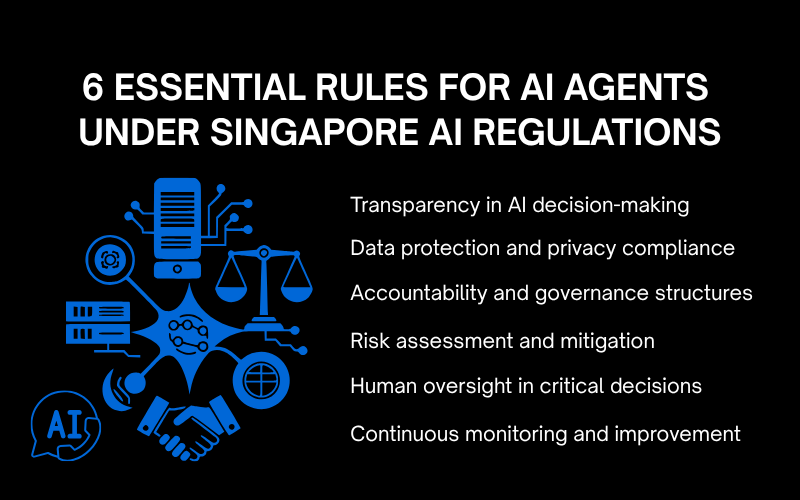
1. Transparency in AI decision-making
AI systems must be explainable.
Users should understand:
- When they are interacting with an AI agent
- How decisions are being made
- What data is being used
Transparency is a fundamental requirement under Singapore AI regulations.
For example, in AI call centers, customers should be informed when they are speaking with an automated system.
Clear communication builds trust and reduces user frustration.
2. Data protection and privacy compliance
Data privacy is a central component of Singapore AI regulations.
Organizations must comply with data protection laws such as:
- Collecting only necessary data
- Securing personal information
- Limiting data usage to defined purposes
AI agents that handle customer data must adhere to strict security protocols.
Failure to protect user data can lead to legal consequences and reputational damage.
3. Accountability and governance structures
Enterprises must establish clear accountability for AI systems.
This includes:
- Assigning responsibility to specific teams
- Defining governance policies
- Monitoring AI system performance
Under Singapore AI regulations, companies cannot treat AI as a “black box.”
There must be clear ownership of how AI systems are deployed and maintained.
4. Risk assessment and mitigation
AI systems must be evaluated for potential risks before deployment.
This includes identifying:
- Bias in decision-making
- Incorrect predictions
- Security vulnerabilities
Risk assessment is a key component of Singapore’s AI regulations, particularly for high-impact applications such as finance and healthcare.
Enterprises must implement mitigation strategies to reduce these risks.
5. Human oversight in critical decisions
AI should not operate without supervision in high-risk scenarios.
For important decisions, such as financial approvals or medical recommendations, human oversight is required.
This principle ensures that AI systems remain aligned with ethical and legal standards.
In practice, Singapore’s AI regulations encourage a hybrid approach in which AI supports humans rather than fully replacing them.
6. Continuous monitoring and improvement
AI systems must be continuously evaluated after deployment.
Enterprises should monitor:
- System accuracy
- User interactions
- Error rates
This ongoing evaluation ensures compliance with Singapore AI regulations over time.
Continuous improvement also helps organizations adapt to new risks and changing regulatory expectations.
At NKKTech Global, AI systems are designed with built-in monitoring pipelines to support long-term compliance and performance optimization.
AI agents and compliance in real-world systems
AI agents are increasingly used in:
- Customer service automation
- Financial advisory systems
- Healthcare support platforms
- E-commerce interactions
In these applications, compliance with Singapore AI regulations is critical.
For example:
An AI call center handling customer data must ensure secure data storage and transparent communication.
A financial AI agent must explain recommendations and avoid biased decision-making.
These real-world scenarios highlight how Singapore AI regulations directly impact system design.
Alignment with global AI regulations
Singapore’s approach to AI governance aligns with global trends.
Many principles found in Singapore AI regulations are similar to:
- GDPR requirements in Europe
- AI risk frameworks in the United States
- Ethical AI guidelines in Australia
This makes Singapore a strategic starting point for companies expanding globally.
By aligning with Singapore AI regulations, enterprises can build systems that are easier to adapt to other markets.
Technology considerations for compliance
To meet regulatory requirements, enterprises must design AI systems with compliance in mind.
Key technical considerations include:
- Secure API architecture
- Data encryption
- Access control systems
- Audit logging
- Explainability features
These components ensure that AI agents comply with the standards set by Singapore’s AI regulations.
Future trends in Singapore AI regulations
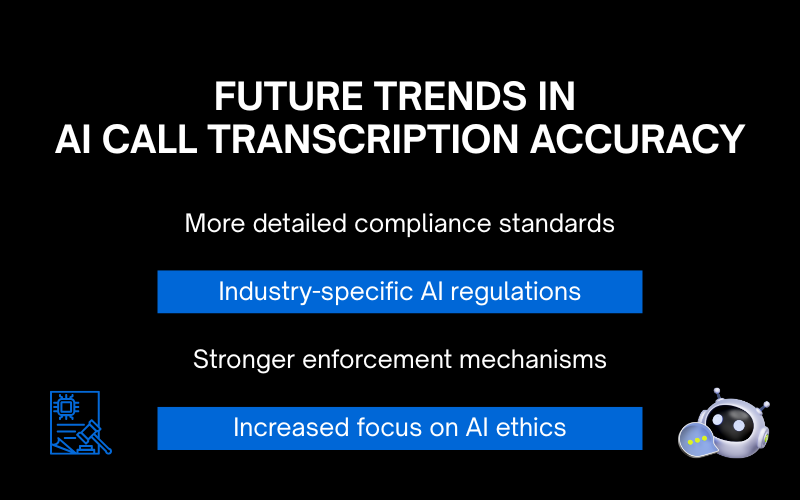
AI governance in Singapore continues to evolve.
Future developments may include:
- More detailed compliance standards
- Industry-specific AI regulations
- Stronger enforcement mechanisms
- Increased focus on AI ethics
Enterprises must stay updated to ensure ongoing compliance with Singapore AI regulations.
Conclusion
AI agents are transforming how businesses operate, but they also introduce new risks and responsibilities.
Understanding Singapore AI regulations allows enterprises to deploy AI systems that are not only effective but also trustworthy and compliant.
From transparency and data protection to governance and continuous monitoring, these principles provide a clear framework for the responsible deployment of AI.
For companies operating in Singapore and beyond, aligning with Singapore AI regulations is essential for long-term success.
Build compliant AI systems with NKKTech Global
At NKKTech Global, we help enterprises design AI systems that meet global compliance standards, including Singapore AI regulations.
Our solutions integrate governance, security, and performance optimization into every stage of AI development.
Whether you are building AI agents, voice AI platforms, or automated customer service systems, our team ensures your technology is both scalable and compliant.
Contact NKKTech Global today to develop AI solutions that meet regulatory standards while driving business growth.
Contact Information:
🌎 Website: https://nkk.com.vn
📩 Email: contact@nkk.com.vn
💼 LinkedIn: https://www.linkedin.com/company/nkktech