
LLM voice tuning is becoming a critical capability for organizations deploying voice AI in real business environments. As enterprises increasingly integrate voicebots into customer support, sales automation, and service operations, ensuring that AI conversations sound natural and accurate is essential.
Without proper LLM voice tuning, voice AI systems may sound robotic, misunderstand context, or respond in ways that feel disconnected from real human conversations. This can lead to poor customer experiences and reduced trust in automated systems.
Modern enterprises are therefore investing in advanced LLM voice tuning strategies that refine how large language models interact with speech recognition systems, intent detection pipelines, and conversational workflows.
At NKKTech Global, engineers working on voice AI systems help organizations implement scalable architectures where LLM voice tuning ensures reliable, human-like conversations across AI call centers and automated customer service platforms.
This article explores five practical LLM voice tuning techniques that help enterprises deploy voice AI systems capable of handling real-world calls effectively.
Why LLM Voice Tuning Matters for Real Customer Calls
Voice AI systems used in controlled demos often perform well. However, real customer calls introduce complexity that requires robust LLM voice tuning.
Real conversations include:
- Accents and varied speech patterns
- Background noise
- Incomplete or fragmented sentences
- Multi-intent questions
- Emotional language from customers
Without effective LLM voice optimization, language models may struggle to interpret these situations correctly.
Proper tuning allows voice systems to:
- Understand conversational context more accurately
- Respond with natural phrasing
- Reduce misunderstandings
- Maintain consistent conversation flows
For enterprises operating customer service platforms, LLM voice tuning directly impacts customer satisfaction and operational efficiency.
Organizations implementing voice automation at scale must treat LLM voice adaptation as a core engineering priority rather than a secondary optimization step.
From Text AI to Voice AI
Large language models were originally designed for text-based interactions. When deployed in voice environments, these models must process additional layers of complexity.
A voice AI system typically includes:
- Speech recognition
- Intent detection
- Language generation
- Speech synthesis
LLM speech tuning helps align these components so that the system responds appropriately during live conversations.
For example, when a customer pauses mid-sentence or corrects themselves, the tuned system can maintain conversational continuity instead of producing awkward responses.
Enterprise Expectations for Voice AI
Enterprise organizations expect voice automation systems to deliver measurable results.
Key expectations include:
- Faster response times
- Reduced call center workload
- Consistent customer interactions
- Accurate understanding of customer requests
Meeting these expectations requires advanced LLM voice tuning to ensure that AI-generated responses match the natural flow of human conversations.
At NKKTech Global, voice AI engineers focus on optimizing conversational models so enterprises can deploy scalable voice platforms capable of handling thousands of real calls daily.
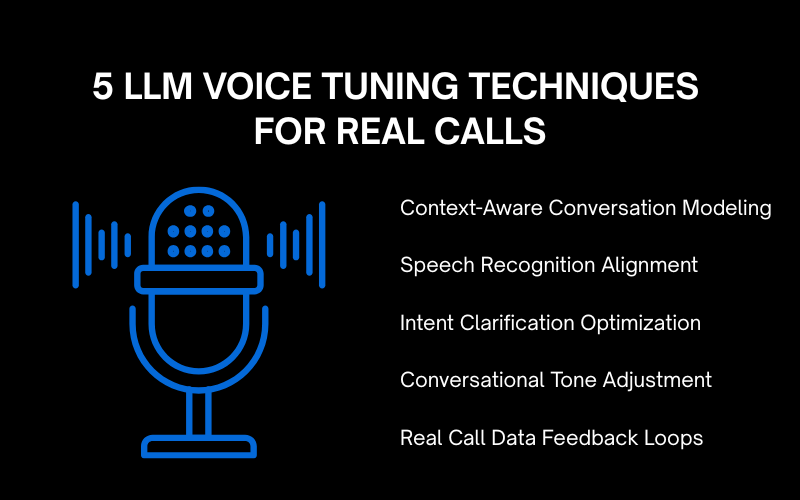
5 LLM Voice Tuning Techniques for Real Calls
Below are five effective LLM voice tuning techniques used in enterprise voice AI systems to improve conversational accuracy and reliability.
1. Context-Aware Conversation Modeling
One of the most important LLM voice tuning techniques involves improving how language models handle conversational context.
Real phone calls rarely follow simple question-and-answer patterns. Customers often provide incomplete information or change topics during a conversation.
Context-aware LLM voice tuning ensures that AI systems can track conversation history and interpret responses correctly.
For example:
Customer:
“I called yesterday about my order.”
A well-tuned system understands that the customer is referencing a previous interaction and can retrieve relevant information instead of asking repetitive questions.
This level of conversational awareness significantly improves customer experience.
2. Speech Recognition Alignment
Another essential LLM voice tuning technique focuses on aligning language models with speech recognition systems.
Speech-to-text engines may occasionally produce imperfect transcriptions due to accents, noise, or pronunciation differences.
LLM voice tuning helps language models interpret imperfect transcripts and infer the intended meaning.
For example, if the speech recognition system transcribes:
“Schedule a meeting tomorrow morning.”
A properly tuned model still understands the request and proceeds with scheduling.
This alignment between transcription and language understanding ensures smoother voice interactions.
3. Intent Clarification Optimization
Real-world customers often express requests in ambiguous ways.
For example:
“I need help with my account.”
Without proper LLM voice tuning, the AI system might struggle to determine the specific issue.
Intent clarification techniques improve how voice AI systems respond to unclear requests.
Instead of guessing, the tuned system asks intelligent follow-up questions such as:
“Are you looking for help with billing, account access, or subscription changes?”
This approach reduces misunderstandings while maintaining natural conversation flow.
4. Conversational Tone Adjustment
Many early voicebots sounded overly robotic because their responses lacked a natural conversational tone.
Modern LLM voice tuning techniques adjust response phrasing to better mimic human communication.
This includes:
- Using shorter sentences
- Avoiding overly technical language
- Adding conversational connectors
- Matching tone with customer intent
For example, instead of responding with:
“Your request has been processed successfully.”
A tuned voice AI might respond with:
“Got it. I’ve scheduled that for you.”
These subtle improvements make automated interactions feel more natural and engaging.
5. Real Call Data Feedback Loops
The most effective LLM voice tuning strategies rely on continuous improvement using real call data.
Enterprise voice systems generate large volumes of conversation logs that provide valuable training signals.
By analyzing real interactions, engineers can identify:
- Common misunderstandings
- Failed intent detections
- Conversation drop-offs
- Repeated clarification loops
These insights help refine LLM voice tuning so that future conversations become more accurate and efficient.
At NKKTech Global, voice AI platforms often include analytics dashboards that enable continuous optimization of conversational models.
Building Scalable Voice AI Systems with LLM Voice Tuning
Implementing effective LLM voice tuning requires a well-designed system architecture that integrates multiple AI technologies.
Enterprise voice platforms typically combine:
- Speech recognition engines
- Large language models
- Dialogue management systems
- Voice synthesis technologies
- CRM and workflow integrations
When properly integrated, these components enable voice AI systems to handle complex customer interactions with high reliability.
For organizations deploying automated call centers, LLM voice tuning plays a crucial role in maintaining consistent service quality.
Voice AI Infrastructure for Enterprises
Large organizations often process thousands of customer calls every day.
This requires voice AI systems that can scale while maintaining performance.
Enterprise-grade LLM voice tuning helps ensure that language models remain stable under high traffic conditions.
Infrastructure considerations include:
- Cloud-based microservices architecture
- Low-latency voice processing pipelines
- Secure API integrations
- Real-time analytics monitoring
Companies that invest in scalable architecture can deploy voice automation across multiple markets and languages.
Future Trends in LLM Voice Tuning

As voice AI technology continues to evolve, LLM voice tuning will become even more important.
Emerging trends include:
- Multilingual voice AI systems
- Emotion-aware conversation models
- Personalized AI assistants
- Cross-channel voice and chat integration
These innovations will allow enterprises to deliver more personalized and responsive customer interactions.
Organizations preparing for these advancements must develop strong LLM voice tuning capabilities today.
Conclusion
Voice AI is rapidly transforming how businesses communicate with customers.
However, deploying voice automation successfully requires more than simply connecting a language model to a speech system.
Effective LLM voice tuning ensures that AI-generated conversations feel natural, accurate, and context-aware during real customer calls.
From context-aware modeling to continuous feedback optimization, these techniques allow organizations to deliver better customer experiences while improving operational efficiency.
For enterprises adopting voice automation at scale, LLM voice tuning is a foundational component of modern AI communication systems.
Build Advanced Voice AI Systems with NKKTech Global
At NKKTech Global, we specialize in developing enterprise-grade voice AI platforms designed for real-world business environments.
Our engineers help organizations implement:
- Scalable voicebot architectures
- Advanced LLM voice tuning pipelines
- AI-powered call center automation
- Intelligent conversational AI systems
If your organization is exploring voice AI technologies or looking to improve conversational accuracy through LLM voice tuning, our team can help design solutions tailored to your business needs.
Contact NKKTech Global today to start building reliable AI voice systems for the future of customer communication.
Contact Information:
🌎 Website: https://nkk.com.vn
📩 Email: contact@nkk.com.vn
💼 LinkedIn: https://www.linkedin.com/company/nkktech