Call centers generate enormous volumes of conversations every day. Hidden inside those conversations is one of the most valuable assets for automation: AI call intent.
When AI systems can accurately identify why a caller is reaching out, they can automate responses, route calls intelligently, assist human agents, and improve the overall customer experience. Without reliable AI call intent detection, even advanced voicebots and contact center platforms struggle to deliver meaningful automation.
Today, enterprises across industries are investing in AI-powered intent models to interpret caller needs in real time. These models form the backbone of modern voice automation systems.
At NKKTech Global, we build enterprise-grade AI solutions that transform raw voice interactions into structured intent signals. Below are five key AI call intent models that power intelligent automation in modern call centers.
Why AI Call Intent Detection Matters
Understanding intent is the difference between a useful automated system and a frustrating one.
When a caller says something like:
- “I want to check my bill.”
- “My payment didn’t go through.”
- “I need to cancel my order.”
The system must identify the exact AI call intent quickly and route the conversation appropriately.
Accurate intent detection enables:
- Faster call resolution
- Reduced agent workload
- Intelligent call routing
- Personalized responses
- Data-driven customer insights
As automation expands, call intent detection modeling becomes one of the most critical components of AI-driven customer service infrastructure.
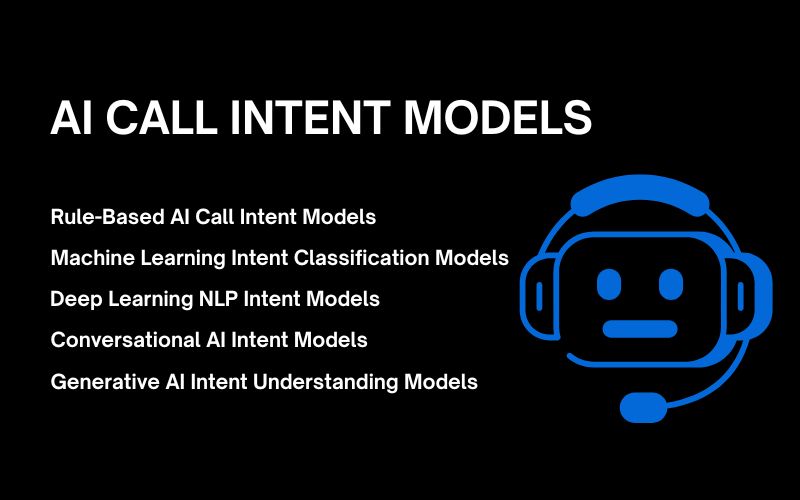
1. Rule-Based AI Call Intent Models
The earliest approach to AI call intent detection relied on rule-based systems.
These models operate through predefined logic such as:
- Keyword matching
- Phrase recognition
- Decision trees
- Pattern-based triggers
For example:
If a caller says “billing” or “invoice,” the system maps the request to a billing intent category.
Advantages
- Easy to implement
- Predictable behavior
- High control over logic
- Suitable for simple workflows
Limitations
However, rule-based AI call intent systems struggle when:
- Customers use unexpected language
- Conversations become complex
- Multiple intents appear in one sentence
For small-scale automation projects, rule-based intent models may still be useful, but modern call centers usually require more advanced approaches.
2. Machine Learning Intent Classification Models
Machine learning significantly improved AI call intent detection.
Instead of relying solely on keywords, these models learn patterns from historical call transcripts.
Typical machine learning methods include:
- Logistic regression classifiers
- Support vector machines
- Random forest algorithms
- Gradient boosting models
These models analyze entire sentences rather than isolated keywords.
Example
The following phrases may be recognized as the same intent:
- “I need help paying my bill.”
- “Can I settle my invoice?”
- “Where do I make payment?”
A trained voice intent recognition classifier learns these relationships from labeled data.
Benefits
- Higher accuracy than rule-based systems
- Ability to recognize varied phrasing
- Scalable training with more data
Many early AI call center automation platforms relied on machine learning models for intent classification.
3. Deep Learning NLP Intent Models
As natural language processing advanced, deep learning models began powering AI call intent detection.
These systems use neural networks to understand language context.
Common architectures include:
- Recurrent neural networks (RNNs)
- Long short-term memory (LSTM) models
- Convolutional neural networks for text
- Transformer-based NLP models
Deep learning models analyze sentence structure, grammar, and semantic meaning.
Why This Matters
Instead of simply detecting keywords, deep learning systems interpret intent within context.
For example:
Caller statement:
“I tried paying online but it didn’t work.”
A deep learning model identifies call intent recognition as a payment issue, not just a general inquiry.
Advantages
- Context-aware intent detection
- Higher accuracy for complex language
- Ability to handle conversational variation
At NKKTech Global, deep learning-based intent models are widely used for enterprise voice automation systems.
4. Conversational AI Intent Models
Modern AI systems combine intent detection with conversation context.
These conversational models treat call intent prediction as dynamic rather than static.
A single call may contain multiple intents:
- Account verification
- Billing inquiry
- Payment request
- Service upgrade
Conversational AI models track intent shifts throughout the interaction.
Key Capabilities
- Multi-turn conversation understanding
- Context retention
- Intent evolution detection
- Dialogue flow optimization
For example:
Caller:
“I want to check my balance.”
Later:
“Actually, I’d like to pay the bill now.”
The system updates the AI voice intent dynamically.
Benefits
- Natural conversation handling
- Reduced need for human intervention
- Improved customer satisfaction
Conversational intent models power advanced voicebots deployed by NKKTech Global for enterprise call centers.
5. Generative AI Intent Understanding Models
The newest generation of AI call intent models leverages large language models and generative AI.
These models understand user intent through deep semantic reasoning.
Capabilities include:
- Interpreting ambiguous requests
- Handling complex sentence structures
- Detecting multiple intents simultaneously
- Generating context-aware responses
Generative AI models analyze meaning rather than relying on predefined intent categories alone.
Example
Caller says:
“I moved recently and my internet hasn’t been activated yet.”
A generative AI system identifies multiple AI call intent elements:
- Address update
- Service activation request
- Potential technical issue
Advantages
- Exceptional language understanding
- Flexible conversation handling
- Reduced need for manual training data
Generative AI is rapidly transforming AI call intent modeling across modern AI call centers.
Core Components Supporting AI Call Intent Models
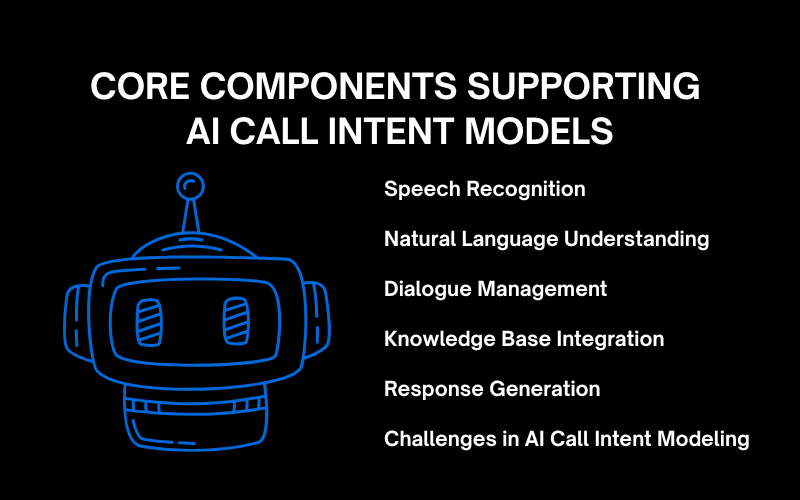
Intent models do not operate in isolation. They are part of a broader AI call automation ecosystem.
Typical components include:
Speech Recognition
Converts caller voice into text for processing.
Natural Language Understanding
Processes the text and identifies AI call intent.
Dialogue Management
Determines how the system should respond.
Knowledge Base Integration
Retrieves relevant information to answer the caller.
Response Generation
Produces appropriate responses through voice synthesis.
Together, these systems enable seamless automation.
Challenges in AI Call Intent Modeling
Even advanced systems face challenges when detecting AI call intent.
Common issues include:
- Strong regional accents
- Mixed-language conversations
- Ambiguous phrasing
- Background noise
- Rapid speech patterns
To address these challenges, enterprises must continuously train and refine their intent models using real call data.
At NKKTech Global, we implement continuous learning pipelines to improve AI call intent accuracy over time.
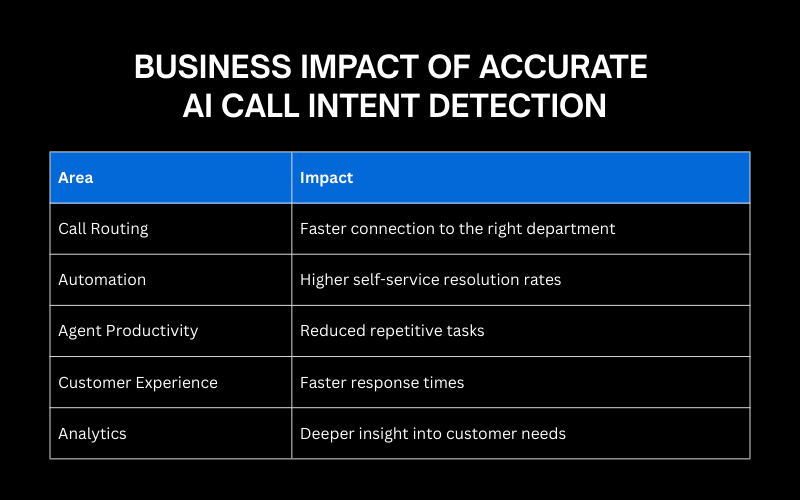
Business Impact of Accurate AI Call Intent Detection
When organizations implement reliable AI call intent models, the benefits are significant.
| Area | Impact |
| Call Routing | Faster connection to the right department |
| Automation | Higher self-service resolution rates |
| Agent Productivity | Reduced repetitive tasks |
| Customer Experience | Faster response times |
| Analytics | Deeper insight into customer needs |
Accurate intent detection is one of the most powerful tools for scaling customer service automation.
Future Trends in AI Call Intent Technology
The future of AI call intent modeling will include:
- Real-time sentiment analysis
- Multilingual intent detection
- Emotion-aware voice AI
- Predictive intent modeling
- AI agents that anticipate caller needs
These technologies will enable AI systems to understand not only what customers say, but also what they truly need.
Enterprises that adopt advanced intent models early will gain a competitive advantage in customer experience automation.
Final Thoughts
Automation in call centers is not just about voicebots or speech recognition. The true intelligence lies in understanding AI call intent.
Intent models transform unstructured conversations into actionable insights. They allow AI systems to respond intelligently, route calls effectively, and automate large portions of customer support operations.
From rule-based models to generative AI systems, AI call intent technology continues to evolve rapidly.
Organizations that invest in advanced intent modeling today will build smarter, faster, and more scalable customer service platforms for the future.
Build Intelligent AI Call Intent Systems with NKKTech Global
At NKKTech Global, we design and deploy advanced AI call intent models for enterprise voice automation.
Our solutions help organizations:
- Develop high-accuracy intent detection systems
- Integrate AI with call center platforms and CRM systems
- Implement conversational AI voicebots
- Continuously train intent models with real call data
- Improve automation rates and customer satisfaction
If your organization is ready to transform call center operations with intelligent voice automation, we can help.
Contact NKKTech Global today to build AI call intent systems that power next-generation automated customer service.
Contact Information:
🌎 Website: https://nkk.com.vn
📩 Email: contact@nkk.com.vn
💼 LinkedIn: https://www.linkedin.com/company/nkktech