Call centers are under pressure like never before. Customer expectations are rising, labor costs are increasing, and businesses must provide fast, accurate service across multiple channels. To address these challenges, organizations are turning to AI-powered voice systems.
But the success of these systems depends on one critical factor: voicebot architecture.
A well-designed voicebot architecture determines how efficiently an AI call center can process conversations, understand user intent, integrate with backend systems, and scale under heavy call volumes. Without the right architecture, even advanced voice AI models can fail to deliver reliable service.
At NKKTech Global, we design enterprise-grade voicebot systems that combine natural language processing, speech recognition, and cloud infrastructure to power scalable AI call centers. Below are seven voicebot architecture designs that help enterprises deploy reliable and scalable voice automation.
Why Voicebot Architecture Matters for AI Call Centers
A voicebot is far more complex than a text-based chatbot. It must manage real-time voice streams, convert speech into text, interpret meaning, generate responses, and synthesize speech — all within seconds.
Effective voicebot architecture ensures:
- Low latency responses during live calls
- Accurate speech recognition
- Seamless integration with CRM and ticketing systems
- Scalability for thousands of simultaneous calls
- Security and compliance for sensitive customer data
Organizations that invest in robust Voice AI architecture can automate large portions of call center interactions while maintaining service quality.
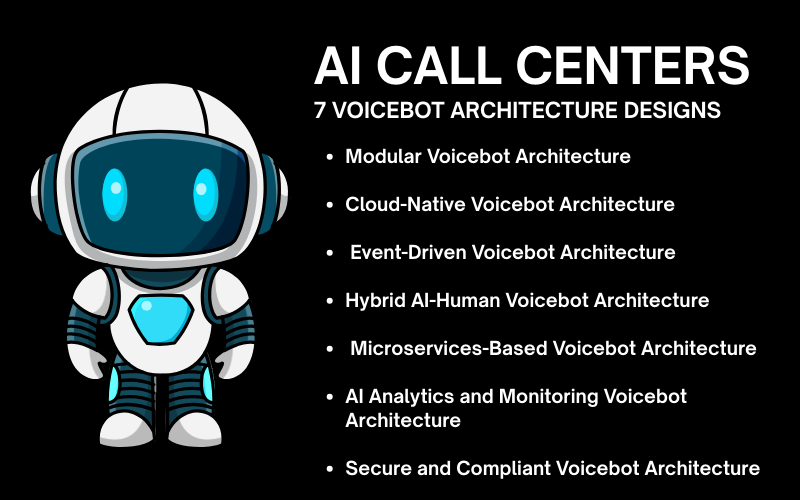
1. Modular Voicebot Architecture
One of the most common designs for enterprise systems is a modular Voice automation architecture.
In this approach, each component of the voice processing pipeline operates independently:
- Speech-to-text (STT) module
- Natural language understanding (NLU) engine
- Dialogue management system
- Business logic layer
- Text-to-speech (TTS) generator
Each module communicates through APIs.
Advantages
- Components can be upgraded independently
- New AI models can be integrated easily
- Failures are isolated to specific modules
- System maintenance becomes easier
For example, if a better speech recognition model becomes available, enterprises can update the STT component without changing the entire Voicebot system design.
This modular design is widely used in scalable AI call center platforms developed by NKKTech Global.
2. Cloud-Native Voicebot Architecture
As call center traffic grows, scalability becomes critical. Cloud-native AI voice infrastructure enables dynamic resource allocation based on real-time demand.
Key characteristics include:
- Containerized services
- Auto-scaling infrastructure
- Distributed processing
- Global availability zones
Cloud-native Intelligent voice automation architecture allows organizations to handle fluctuating call volumes without overprovisioning infrastructure.
Benefits
- Reduced infrastructure cost
- High availability
- Elastic scaling during peak hours
- Faster deployment cycles
Companies operating across multiple regions, such as Singapore and Australia, often rely on cloud-native Voice automation system design to support global customer service operations.
3. Event-Driven Voicebot Architecture
Real-time communication systems benefit greatly from event-driven architecture.
In this design, voicebot components respond to events rather than relying on synchronous requests.
Typical events include:
- Incoming call initiation
- Speech recognition completion
- Intent detection results
- Customer data retrieval
- Escalation triggers
A message broker distributes events across the AI voice platform architecture.
Why This Works
- Improves responsiveness
- Enables asynchronous processing
- Supports high concurrency
- Enhances fault tolerance
Event-driven AI voice infrastructure is especially useful in AI call centers handling thousands of simultaneous conversations.
At NKKTech Global, we frequently deploy event-driven designs to optimize large-scale voice automation systems.
4. Hybrid AI-Human Voicebot Architecture
While voicebots can handle many customer interactions, some cases require human intervention.
Hybrid Voice assistant architecture integrates AI automation with live agent support.
In this design:
- Voicebot handles initial conversation.
- AI determines complexity level.
- Calls requiring human assistance are transferred.
- Context and conversation history are shared with the agent.
Advantages
- Maintains service quality for complex issues
- Reduces workload for human agents
- Improves customer satisfaction
- Supports gradual AI adoption
Hybrid Speech AI system architecture ensures that automation enhances — rather than replaces — human service capabilities.
NKKTech Global builds hybrid call center solutions that maintain seamless transitions between AI systems and human operators.
5. Microservices-Based Voicebot Architecture
Large enterprises benefit from microservices-based Intelligent voice automation architecture.
In this model, each functional component operates as an independent service.
Examples include:
- Voice streaming service
- Speech recognition service
- Language processing service
- Dialogue orchestration service
- Analytics service
Each service can be deployed, scaled, and monitored separately.
Strategic Benefits
- Faster development cycles
- Independent service scaling
- Greater system resilience
- Easier integration with external platforms
Microservices-based Voice automation system design allows organizations to evolve their AI call center systems continuously without disrupting operations.
6. AI Analytics and Monitoring Voicebot Architecture
AI call centers generate valuable operational data. An advanced voicebot architecture includes dedicated analytics and monitoring components.
These components track:
- Conversation success rates
- Intent recognition accuracy
- Call duration metrics
- Customer sentiment trends
- Escalation frequency
Analytics dashboards provide insights into voicebot performance and customer behavior.
Operational Benefits
- Continuous optimization of conversation flows
- Early detection of performance issues
- Data-driven decision-making
- Improved customer experience
NKKTech Global integrates advanced monitoring systems within Voice interface architecture to ensure continuous performance improvement.
7. Secure and Compliant Voicebot Architecture
Security and compliance are essential in industries such as finance, healthcare, and telecommunications.
A secure voicebot architecture includes:
- Encrypted voice streams
- Secure API gateways
- Identity verification systems
- Access control mechanisms
- Compliance auditing tools
Customer voice interactions often contain sensitive data such as account numbers or personal identifiers.
Proper Voicebot system design must protect this information through robust security frameworks.
At NKKTech Global, we design voicebot systems aligned with international data protection standards and enterprise security policies.
Key Components of Modern Voicebot Architecture
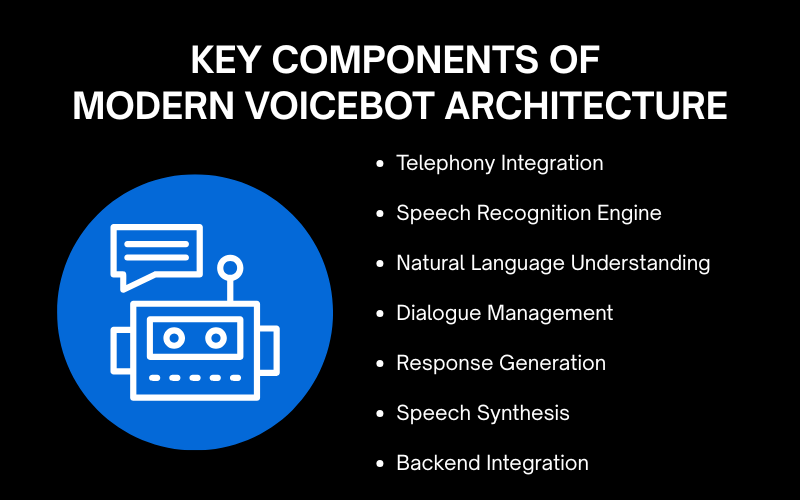
Regardless of design style, enterprise Voicebot system design typically includes these core components:
Telephony Integration
Handles inbound and outbound calls through VoIP or SIP systems.
Speech Recognition Engine
Converts spoken language into text for processing.
Natural Language Understanding
Interprets user intent and extracts key information.
Dialogue Management
Controls conversation flow and decision-making.
Response Generation
Creates appropriate responses using predefined rules or AI models.
Speech Synthesis
Converts responses back into natural-sounding voice output.
Backend Integration
Connects with CRM systems, databases, and knowledge bases.
Together, these components form the backbone of an AI call center voicebot architecture.
Challenges in Voicebot Architecture Design
Implementing voicebot systems involves several challenges:
- Managing latency in real-time conversations
- Ensuring accurate speech recognition across accents
- Integrating legacy systems
- Maintaining conversation context across long interactions
- Scaling infrastructure efficiently
Organizations that attempt to build voicebot systems without proper architectural planning often face performance limitations and customer dissatisfaction.
NKKTech Global helps enterprises overcome these challenges through structured architecture design and integration expertise.
The Future of Voicebot Architecture
Voicebot technology is evolving rapidly. Future voicebot architecture designs will likely incorporate:
- Generative AI for dynamic conversation generation
- Emotion detection through voice analysis
- Multilingual speech recognition capabilities
- AI agents coordinating across customer channels
- Advanced predictive analytics
These advancements will make AI call centers even more capable of handling complex customer interactions autonomously.
Enterprises that invest in scalable Voice AI architecture today will be well-positioned to adopt these innovations in the future.
Final Thoughts
AI-powered voice automation is transforming the way call centers operate. However, technology alone does not guarantee success.
The true foundation of reliable voice automation is a well-designed voicebot architecture.
From modular systems and cloud-native infrastructure to hybrid human-AI designs and advanced analytics, the right architecture ensures that voicebots deliver accurate, efficient, and scalable customer service.
Organizations that prioritize Speech AI system architecture can reduce operational costs, improve response times, and enhance customer satisfaction across global markets.
Build Enterprise Voicebot Architecture with NKKTech Global
At NKKTech Global, we specialize in designing and deploying scalable AI voice infrastructure for enterprise AI call centers.
Our team helps organizations:
- Design modular and microservices-based voicebot systems
- Integrate voice AI with CRM and telephony platforms
- Implement real-time analytics and monitoring
- Ensure security and regulatory compliance
- Optimize performance for high-volume call environments
If your organization is planning to modernize its call center with AI voice technology, the right architecture is the first step.
Contact NKKTech Global today to build a voicebot architecture that powers intelligent, scalable, and future-ready AI call centers.
Contact Information:
🌎Website: https://nkk.com.vn
📩Email: contact@nkk.com.vn
💼LinkedIn: https://www.linkedin.com/company/nkktech