
Artificial Intelligence projects scale fast. So do their bills.
Training models, storing data, running inference engines, managing pipelines — all of it consumes cloud resources at a speed most finance teams underestimate. That is why cloud cost optimization has become a board-level conversation for companies investing in AI.
In 2025, enterprises across Australia, Singapore, the US, Europe, and Japan are no longer asking how to scale AI. They are asking how to scale it sustainably. Without structured cloud cost optimization, even high-performing AI initiatives can quietly erode margins.
At NKKTech Global, we help organizations deploy AI systems that are not only intelligent — but financially efficient. Below are four practical cloud cost optimization strategies specifically designed for AI workloads.
Why Cloud Cost Optimization Is Critical for AI Projects
AI infrastructure is fundamentally different from traditional workloads.
AI systems require:
- High-performance compute (GPU/TPU instances)
- Large-scale data storage
- Continuous training cycles
- Real-time inference environments
- Redundancy for reliability
These components drive rapid cloud spend growth. Without disciplined cloud cost optimization, costs increase exponentially as AI usage expands.
The goal is not to cut resources blindly. The goal is intelligent allocation.
1. Optimize Compute Usage with Right-Sizing and Auto-Scaling

The biggest AI expense typically comes from compute power.
Many companies over-provision GPU instances “just in case.” That habit alone can double monthly costs.
Effective cost optimization starts with:
- Right-sizing compute instances based on actual workload
- Separating training and inference environments
- Implementing auto-scaling policies
- Shutting down idle development environments
For example:
- Training clusters can be provisioned temporarily.
- Inference servers can scale dynamically based on real traffic.
At NKKTech Global, we conduct compute audits to identify underutilized resources and redesign AI architectures for elastic scaling — a core cloud cost optimization practice.
Business Impact:
- Reduced idle GPU spend
- Lower infrastructure waste
- Better cost predictability
2. Use Tiered Storage and Data Lifecycle Management
AI models rely on massive datasets, but not all data needs high-speed storage at all times.
Cloud cost management requires structured storage strategies:
- Frequently accessed data → High-performance storage
- Historical data → Lower-cost object storage
- Archived datasets → Cold storage tiers
Implement data lifecycle policies to:
- Automatically move inactive datasets
- Delete redundant logs
- Compress raw training artifacts
AI teams often retain everything “for safety,” but unmanaged storage growth quietly inflates cloud bills.
At NKKTech Global, we implement automated lifecycle management policies as part of AI-focused cloud cost optimization frameworks.
Financial Result:
- 20–40% reduction in storage costs
- Lower long-term data overhead
- Cleaner data environments
3. Optimize AI Model Training Efficiency
Inefficient model training is one of the most overlooked cloud cost management gaps.
Common issues include:
- Re-training models unnecessarily
- Using oversized datasets
- Running experiments without version control
- Failing to cache intermediate outputs
Cloud cost reduction in AI training includes:
- Using incremental training instead of full retraining
- Applying transfer learning where possible
- Scheduling training during lower-cost compute windows
- Implementing experiment tracking systems
When training cycles are optimized, compute time decreases significantly.
NKKTech Global integrates MLOps best practices to ensure AI training pipelines are structured for both performance and cloud cost optimization.
Strategic Benefit:
- Faster development cycles
- Lower experimentation cost
- Improved budget control
4. Implement FinOps Governance for AI Workloads
Technology alone does not guarantee cloud cost optimization. Governance does.
Enterprises that succeed implement:
- Budget thresholds per AI project
- Real-time cost dashboards
- Department-level usage visibility
- Automated alerts for cost spikes
- Accountability ownership models
FinOps (Financial Operations) practices bring transparency to AI cloud consumption.
Without governance, AI teams optimize for performance only — not efficiency.
At NKKTech Global, we help enterprises integrate FinOps frameworks directly into AI deployment pipelines, ensuring continuous cloud cost optimization across departments.
Operational Advantage:
- Predictable cloud budgets
- Early detection of overspending
- Cross-team accountability
- Long-term cost sustainability
Hidden Cloud Cost Optimization Mistakes in AI
Even mature organizations fall into these traps:
- Leaving experimental environments running
- Overusing premium managed AI services without evaluation
- Ignoring data duplication
- Failing to monitor inference scaling patterns
- Separating engineering from finance discussions
True cloud cost optimization requires collaboration between technical teams and financial leadership.
AI innovation should never compromise financial discipline.
How Cloud Cost Optimization Supports AI Scalability
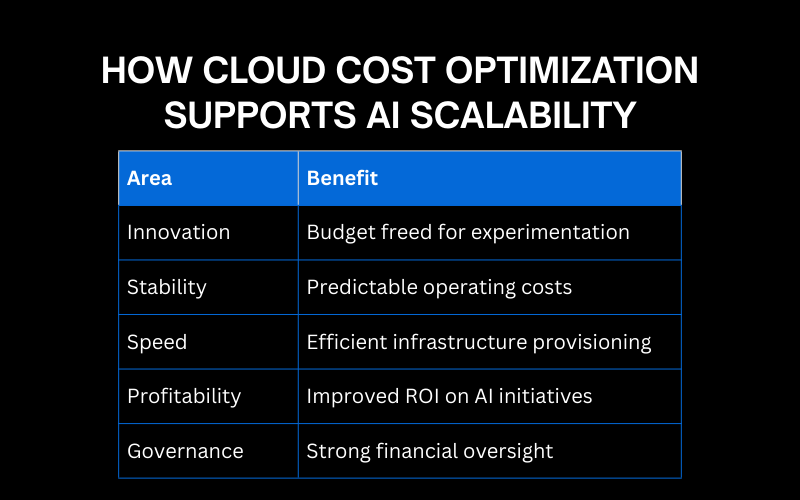
When cloud cost optimization is embedded into AI strategy, organizations gain:
| Area | Benefit |
| Innovation | Budget freed for experimentation |
| Stability | Predictable operating costs |
| Speed | Efficient infrastructure provisioning |
| Profitability | Improved ROI on AI initiatives |
| Governance | Strong financial oversight |
This is not about cutting corners. It is about enabling long-term AI scalability.
Why 2025 Demands Structured Cloud Cost Optimization
Global AI adoption is accelerating. Regulatory requirements are increasing. Energy costs are rising. Cloud providers continue adjusting pricing models.
Enterprises that ignore cloud cost optimization risk:
- Budget overruns
- CFO resistance to AI expansion
- Reduced innovation capacity
- Lower profit margins
AI growth must be paired with financial engineering.
Organizations in Australia, Singapore, the US, Europe, and Japan are prioritizing cloud cost optimization as part of their broader digital transformation strategies.
Conclusion
AI success is not defined only by model accuracy. It is defined by sustainable deployment.
Without structured cloud cost optimization, AI projects become expensive experiments. With disciplined cost management, AI becomes a scalable competitive advantage.
Compute efficiency, storage management, training optimization, and governance frameworks are the four pillars of intelligent cloud cost optimization for AI.
If your AI infrastructure is growing faster than your cost visibility, now is the time to act.
Build Efficient AI Infrastructure with NKKTech Global
At NKKTech Global, we design AI systems with cloud cost optimization embedded from day one.
We help enterprises:
- Audit and restructure AI cloud architecture
- Implement right-sizing and auto-scaling policies
- Optimize model training pipelines
- Deploy FinOps governance frameworks
- Achieve measurable ROI on AI investments
If you want to scale AI without scaling cloud waste, we are ready to help.
Contact NKKTech Global today to implement a strategic cloud cost optimization plan that strengthens both innovation and profitability.
Contact Information:
🌎Website: https://nkk.com.vn
📩Email: contact@nkk.com.vn
💼LinkedIn: https://www.linkedin.com/company/nkktech