
Introduction: Why AI Voice UX Now Directly Impacts Revenue
AI voice UX is no longer experimental. It is revenue infrastructure.
Across Singapore, the US, Europe, and Australia, enterprises are rapidly embedding voice interfaces into contact centers, ecommerce journeys, fintech onboarding, insurance claims processing, and smart retail environments. Customers now expect voice interactions to be immediate, intelligent, and frictionless.
When AI voice UX is designed correctly, it reduces cognitive load, increases perceived trust, and accelerates decision cycles. When poorly designed, it quietly erodes revenue. Drop-offs rise. Escalations increase. Conversion stalls.
Many enterprises invest heavily in speech recognition engines, LLM integration, and voice analytics pipelines—but underestimate the UX layer. The result is not technical failure. It is design failure.
At NKKTech Global, we consistently see that conversion does not break because AI cannot understand language. It breaks because the conversational journey is poorly structured.
Let’s break down four expensive mistakes—and how to redesign AI voice UX for measurable growth across mature markets.
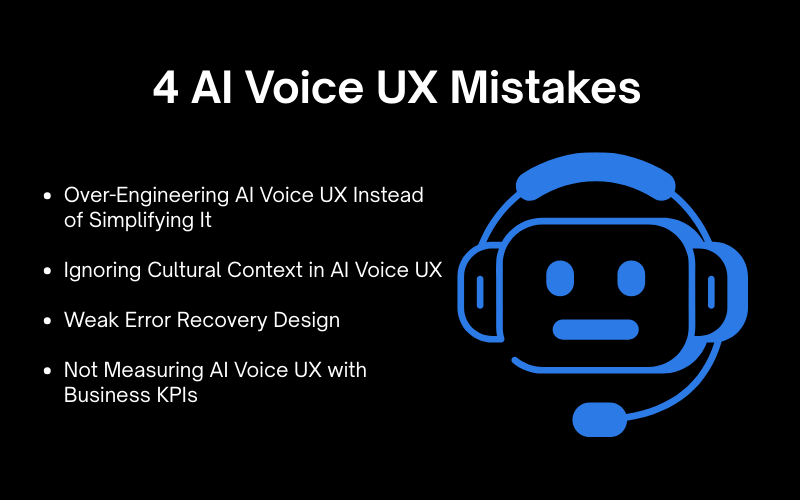
1. Over-Engineering AI Voice UX Instead of Simplifying It
The Mistake: Too Many Steps, Too Much Intelligence
In the US and Europe especially, product teams often attempt to showcase “intelligence” in early deployments. They design systems that try to handle every possible edge case in version one. They stack branching logic. They embed multi-question prompts. They build conversational trees that look impressive in diagrams.
But voice is not a website. It is linear. It unfolds sequentially. Users cannot scan options visually. They must process information in time.
When AI voice UX becomes overly complex, users:
- Interrupt the system
- Repeat answers
- Forget previous prompts
- Drop off mid-flow
- Ask for human escalation
In Singapore and Australia, where users prioritize efficiency over novelty, over-engineered voice systems perform particularly poorly.
Why It Hurts Conversion
Complex voice journeys increase cognitive load. Every extra mental step reduces completion rate. Users must:
- Remember account numbers
- Parse long instructions
- Guess acceptable formats
- Interpret vague confirmations
The friction compounds. Conversion declines silently.
The Fix: Design AI Voice UX Like a Straight Path
High-performing conversational systems follow simple rules:
- One intent per prompt
- Short, structured options
- Minimal confirmation loops
- Clear next-step framing
Instead of asking for three data points at once, break interactions into micro-steps. Confirm only critical information. Avoid showing off technical intelligence at the expense of clarity.
In mature markets, simplicity wins. Clarity converts.
2. Ignoring Cultural Context in AI Voice UX

The Mistake: Generic Global Voice Design
Voice behavior expectations differ significantly between regions.
In Singapore, users expect efficiency and professionalism.
In the US, tone influences brand perception strongly.
In Europe, privacy sensitivity shapes conversational tolerance.
In Australia, conversational naturalness affects trust levels.
Designing one global template and deploying it everywhere leads to subtle but costly friction.
For example:
- Overly casual tone may reduce credibility in Singapore.
- Over-scripted responses feel robotic in the US.
- Aggressive upselling prompts reduce trust in parts of Europe.
- Excess verbosity frustrates Australian users.
These are not technical failures—they are UX alignment failures.
Why It Hurts Conversion
Trust is fragile in voice environments. Without visual reinforcement, tone and pacing carry more weight. When the system feels “off,” users disengage faster than in visual interfaces.
Conversion drops not because the AI is wrong—but because it feels misaligned.
The Fix: Localized Conversational Design Strategy
Winning conversational systems require:
- Tone calibration per market
- Regional pacing adjustments
- Context-aware politeness design
- Market-specific interruption handling
In Singapore and Australia, concise efficiency consistently outperforms verbose friendliness. In the US, personalization signals improve engagement. In Europe, transparency messaging improves compliance trust.
Localization is not translation. It is behavioral alignment.
3. Weak Error Recovery Design
The Mistake: Poor Handling of Misunderstandings
Speech systems will mishear. Background noise, accent variation, connection quality—these are unavoidable variables.
The real issue is not misrecognition. It is poor recovery design.
Common weak patterns include:
- Repeating identical prompts
- Saying “I didn’t understand” without guidance
- Resetting the entire flow
- Escalating too early without context
This destroys user confidence.
Why It Hurts Conversion
When recovery logic is weak:
- Frustration spikes
- Session duration increases
- Drop-off rates climb
- Human handling cost rises
Users need direction, not repetition.
In the US and Europe, where users are quick to abandon inefficient experiences, poor recovery logic directly impacts revenue per interaction.
The Fix: Smart Recovery Framework
Effective error recovery includes:
- Rephrased prompts
- Context-aware clarification
- Example-based guidance
- Limited retries
- Escalation with preserved context
Instead of:
“I didn’t understand.”
Use:
“Sorry, I didn’t catch the order number. It should be 6 digits. Please say it again.”
Recovery is not a fallback. It is part of the primary experience.
4. Not Measuring AI Voice UX with Business KPIs

The Mistake: Tracking Technical Metrics Only
Many teams measure:
- Recognition accuracy
- Latency
- API response time
But they fail to measure:
- Conversion rate
- Completion rate
- Drop-off points
- Escalation frequency
- Revenue per interaction
- Average task time
Optimizing recognition accuracy while ignoring conversion metrics leads to false confidence.
Why It Hurts Conversion
If UX optimization is disconnected from revenue metrics, teams improve the wrong variables. A system may “sound smarter” while conversion remains flat.
That is not growth.
In Singapore and Australia especially, enterprises demand measurable ROI. Without KPI alignment, voice programs struggle to scale beyond pilot phases.
The Fix: Conversion-Centric Analytics
Enterprise-grade systems should include:
- Funnel mapping per interaction flow
- Intent-level drop-off analysis
- Revenue attribution modeling
- Continuous prompt A/B testing
- Escalation cost modeling
AI voice UX must be evaluated like a revenue channel—not a tech demo.
How NKKTech Global Builds High-Converting AI Voice UX
NKKTech Global approaches conversational design as business infrastructure, not a side experiment.
Our frameworks focus on:
- Friction reduction
- Trust amplification
- Decision acceleration
- Operational cost control
- Scalable engagement
Across Singapore, the US, Europe, and Australia, enterprises require stability, compliance alignment, and measurable performance uplift. That requires disciplined UX architecture—not just AI capability.
Voice is not the future. It is already embedded in enterprise systems.
The only question is whether your voice experience converts—or leaks revenue.
Conclusion: Fix AI Voice UX Before Scaling AI
Investing in voice AI without strong UX architecture is risky.
Before scaling deployments, audit your system across:
- Simplicity
- Cultural alignment
- Recovery strength
- KPI integration
Most conversion failures in voice channels are UX failures—not model failures.
If your AI voice UX is not producing measurable conversion improvement, redesign is not optional.
NKKTech Global helps enterprises transform conversational systems into scalable conversion engines across Singapore, the US, Europe, and Australia.
Voice is intimate. Voice is immediate. Voice converts—when designed with precision.
Contact Information:
🌎 Website: https://nkk.com.vn
📩 Email: contact@nkk.com.vn
📌 LinkedIn: https://www.linkedin.com/company/nkktech