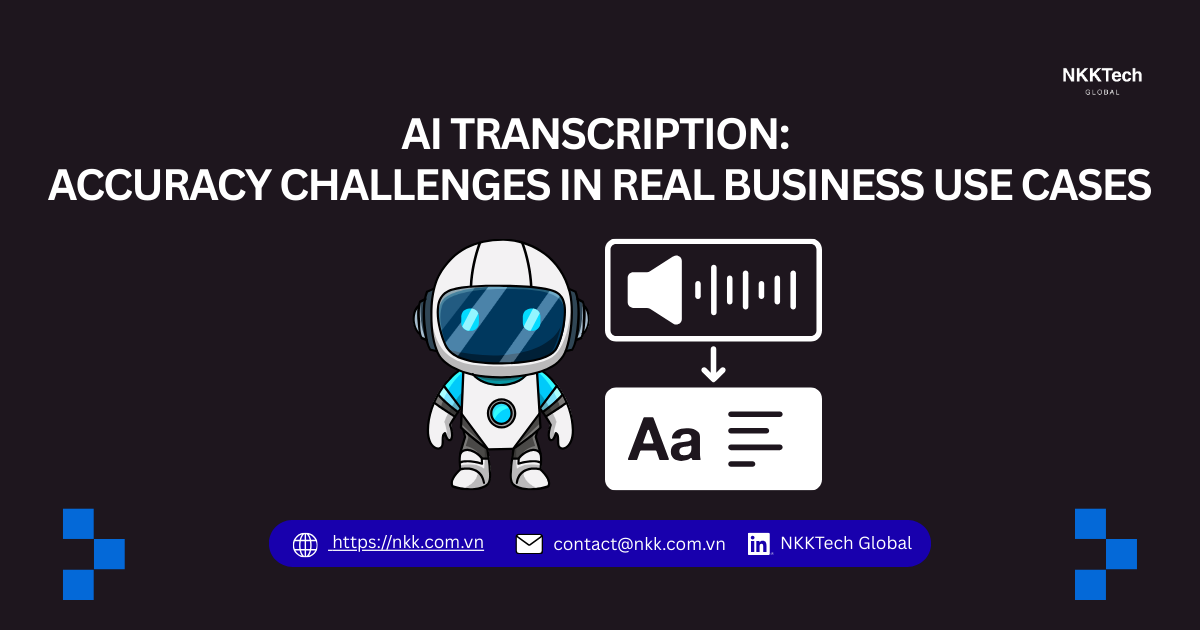
AI Transcription has evolved far beyond basic speech-to-text functionality. In modern enterprise environments, it is embedded across customer support, internal meetings, compliance workflows, sales calls, and industry-specific operations. As adoption increases, one factor consistently determines success or failure: accuracy under real-world conditions.
For enterprises, AI Transcription accuracy is not merely a technical metric. It directly affects operational efficiency, regulatory exposure, customer experience, and the quality of business decisions. At NKKTech Global, we treat transcription as a production-grade system—not a demo—designed to handle noisy audio, domain-specific language, and real operational constraints.
Why AI Transcription Accuracy Matters in Business Operations
In controlled environments, automated speech recognition often appears highly reliable. In real business use cases, however, audio is rarely clean or predictable. Conversations overlap, accents vary, background noise is common, and speakers rely heavily on industry jargon that generic models fail to recognize.
When transcription quality degrades, enterprises face:
- Misinterpreted customer requests
- Incorrect meeting notes or documentation
- Compliance risks in regulated industries
- Loss of trust in AI-driven workflows
Accuracy determines whether speech-to-text becomes a dependable operational capability or an abandoned experiment.
What “Accuracy” Really Means in AI Transcription
Accuracy in AI Transcription is often reduced to a single percentage score. In real business environments, it is multi-dimensional.
Word-Level vs. Business-Level Accuracy
Metrics such as Word Error Rate (WER) are useful, but enterprises care far more about whether:
- Key entities are captured correctly
- Intent and meaning are preserved
- Critical phrases remain
In a customer support call, missing a product name or contractual term is far more damaging than mishearing filler words. At NKKTech Global, accuracy is defined by business impact—not model benchmarks alone.
Context Awareness and Domain Understanding
Generic transcription systems struggle with:
- Industry-specific terminology
- Company-level acronyms
- Multilingual or code-switching speech
Without domain adaptation, even high-quality models fail once deployed. This gap between pilot success and production performance is one of the most common challenges enterprises encounter.
Common Accuracy Challenges in Real AI Transcription Use Cases
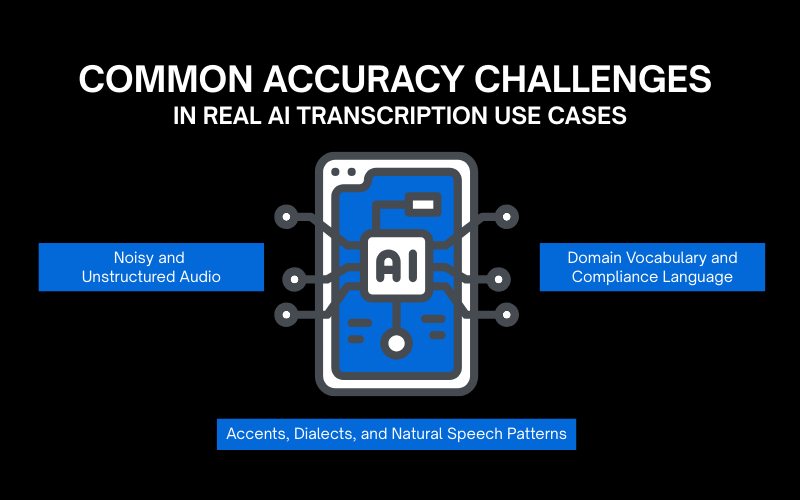
Accuracy degrades rapidly when systems encounter real operational complexity.
Noisy and Unstructured Audio
Enterprise audio frequently includes background noise from offices, factories, or call centers, overlapping speakers, and inconsistent microphone quality. These conditions significantly reduce reliability if not addressed at the system level.
NKKTech Global mitigates this through audio preprocessing, speaker diarization, and confidence-based filtering before transcription results reach end users.
Accents, Dialects, and Natural Speech Patterns
Global organizations operate across regions, each with distinct accents, speech speed, and informal language patterns. Accuracy drops sharply when systems are not evaluated against real user populations. This is why real audio sampling is essential during MVP and pilot phases.
Domain Vocabulary and Compliance Language
In finance, healthcare, manufacturing, or legal environments, transcription errors are unacceptable. Missing or altering a single term can introduce compliance or operational risk. Effective systems require custom vocabularies, context-aware post-processing, and human validation for critical segments.
Measuring Accuracy the Right Way
Many enterprises struggle not because transcription is inaccurate, but because performance is measured incorrectly.
Beyond WER, NKKTech Global recommends tracking:
- Entity accuracy (names, numbers, product codes)
- Intent preservation
- Task completion success
- Error severity, not just frequency
This aligns system performance with business outcomes.
Designing AI Transcription Systems for Real Accuracy
Accuracy challenges cannot be solved by models alone. They require system-level design decisions.
Improving results often starts before inference. Noise reduction, silence detection, and speaker separation significantly affect outcomes. Confidence scoring and human review loops ensure that high-risk outputs trigger manual validation or fallback workflows.
Integration with CRM systems, knowledge bases, and structured workflows further reduces ambiguity and improves downstream reliability.
How NKKTech Global Delivers Accurate AI Transcription in Production
At NKKTech Global, AI Transcription systems are built with production realities in mind. Architectures emphasize domain adaptation from day one, modular pipelines, continuous monitoring, and auditability. Accuracy is not optimized once—it is maintained over time.
Human-in-the-loop workflows are designed intentionally, ensuring the right balance between automation and control. Systems scale securely across teams and regions while respecting enterprise compliance and data privacy requirements.
Conclusion
AI Transcription accuracy is the defining factor between experimental tools and enterprise-ready systems. Real business environments expose challenges that demos cannot predict. Addressing them requires a holistic approach combining technology, process, and governance.
Connect with NKKTech Global to explore a long-term partnership in building accurate, production-ready transcription systems tailored to real business use cases.
Contact Information:
🌎 Website: https://nkk.com.vn
📩 Email: contact@nkk.com.vn
📌 LinkedIn: https://www.linkedin.com/company/nkktech